

The biggest announcements across AI, Microsoft Security and cloud and what they mean for organisations looking to innovate with confidence.
Microsoft Ignite 2026 presented a future in which AI no longer sits alongside everyday work as a separate assistant. It participates in projects, connects organisational knowledge, uses business tools and takes action across increasingly complex workflows.
That direction creates a significant opportunity for organisations using Microsoft technology, but it also changes the leadership challenge. As AI systems become more autonomous, the boundaries between productivity, data, identity, infrastructure and cyber security become harder to separate.
The central message from Ignite was therefore bigger than the individual product announcements. Microsoft is building towards an intelligent operating environment in which people and agents work across shared data, applications and infrastructure. To create sustainable value from that environment, organisations will need to advance AI innovation and cyber resilience together.
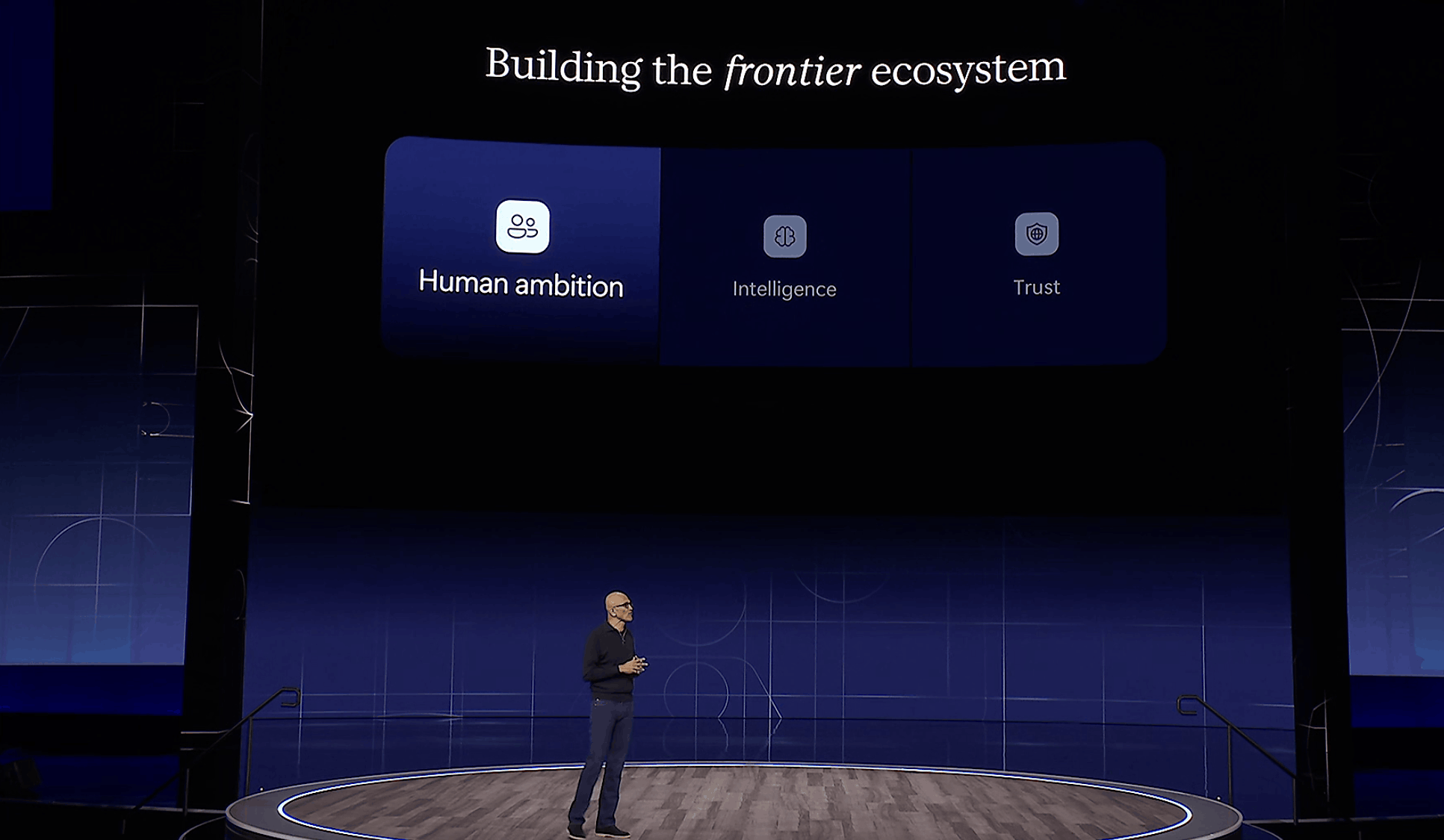
The Keynote in One Sentence: AI Innovation & Cyber Resilience Must Advance Together
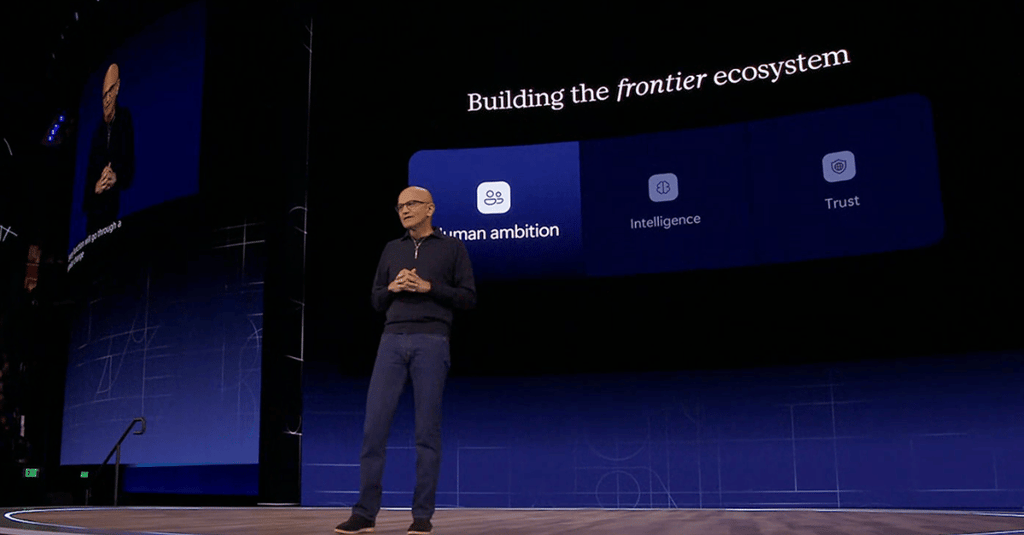
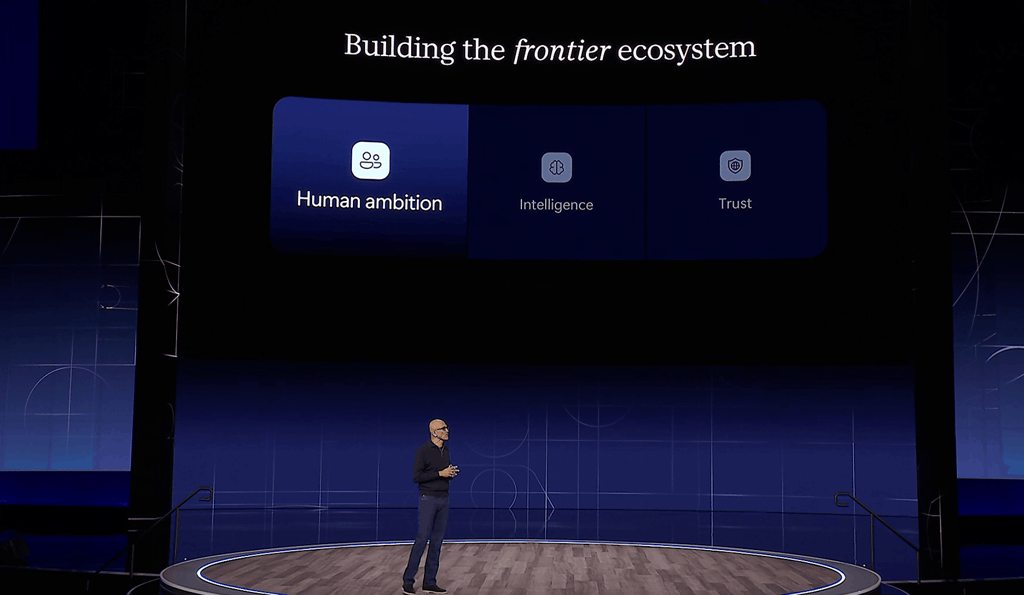
Three ideas ran through the keynote: human ambition provides the purpose for innovation, organisational intelligence provides the context and trust provides permission to operate at scale.
These ideas should not be treated as separate technology themes. Together, they describe the operating model Microsoft is developing across Copilot, AI agents, Microsoft IQ, Agent 365, Azure and Microsoft Security.
This is the strategic shift beneath the event’s extensive list of announcements. Organisations are moving from adopting individual AI tools to building intelligent business systems. In those systems, people and agents act across shared workflows, use the same organisational information and depend on connected identities, applications and infrastructure.
The potential value is substantial. Agents could coordinate work, analyse information, support decisions and complete processes that currently require repeated handovers between people and systems. Yet greater autonomy also increases the consequences of poor information, excessive access, weak accountability or fragmented security.
For leaders, the immediate priority is not to deploy the largest possible number of agents. It is to establish the foundations on which useful and governable AI can operate.
CyberOne’s analysis of what security leaders should watch at Microsoft Ignite provides a practical framework covering identity, data security, security operations, deployment readiness and measurable outcomes.
Human Ambition: Moving from Assistance to Accountable Action
Microsoft’s Copilot announcements reflected a clear move from assistance towards action. Developments including Copilot Home, Copilot Today, Copilot Autopilot, Copilot Workspaces, Copilot Code and Office in Copilot are designed to make AI a more persistent participant in everyday work.
-
Copilot Home: A central destination for AI-powered work, bringing conversations, information and activities together.
-
Copilot Today: A more proactive experience that helps users understand their priorities and stay informed.
-
Copilot Autopilot: An AI agent capable of continuing projects, performing recurring activities and following up on tasks.
-
Copilot Workspaces: Shared environments where people and AI agents collaborate around common projects and outcomes.
-
Copilot Code: Natural-language application creation, making it easier to turn business requirements into working solutions.
-
Office in Copilot: Deeper integration of Word, Excel and PowerPoint into the Copilot experience.
Instead of responding to an isolated prompt, Copilot could help maintain the context of a project, identify priorities, continue recurring activities or work with people inside a shared workspace. Copilot Cowork and intelligent model selection extend this direction by allowing different tasks to use an appropriate level of reasoning, performance and cost.
The commercial opportunity is not limited to saving a few minutes on routine tasks. Properly deployed, these capabilities could help organisations redesign workflows, reduce unnecessary administration and make specialist knowledge available more consistently. Employees could spend more time on decisions, relationships and creative work while agents handle predictable coordination and information-processing activities.
However, moving from a tool that recommends an action to an agent that performs it changes the risk equation. An autonomous capability needs more than a user licence and a technical configuration. It needs an accountable owner, a defined purpose and clear operational boundaries.
Leaders should know which identity an agent uses, which information and tools it can access, which actions require approval and how its behaviour will be monitored. They also need a way to revoke access quickly when the agent’s role, owner or risk profile changes.
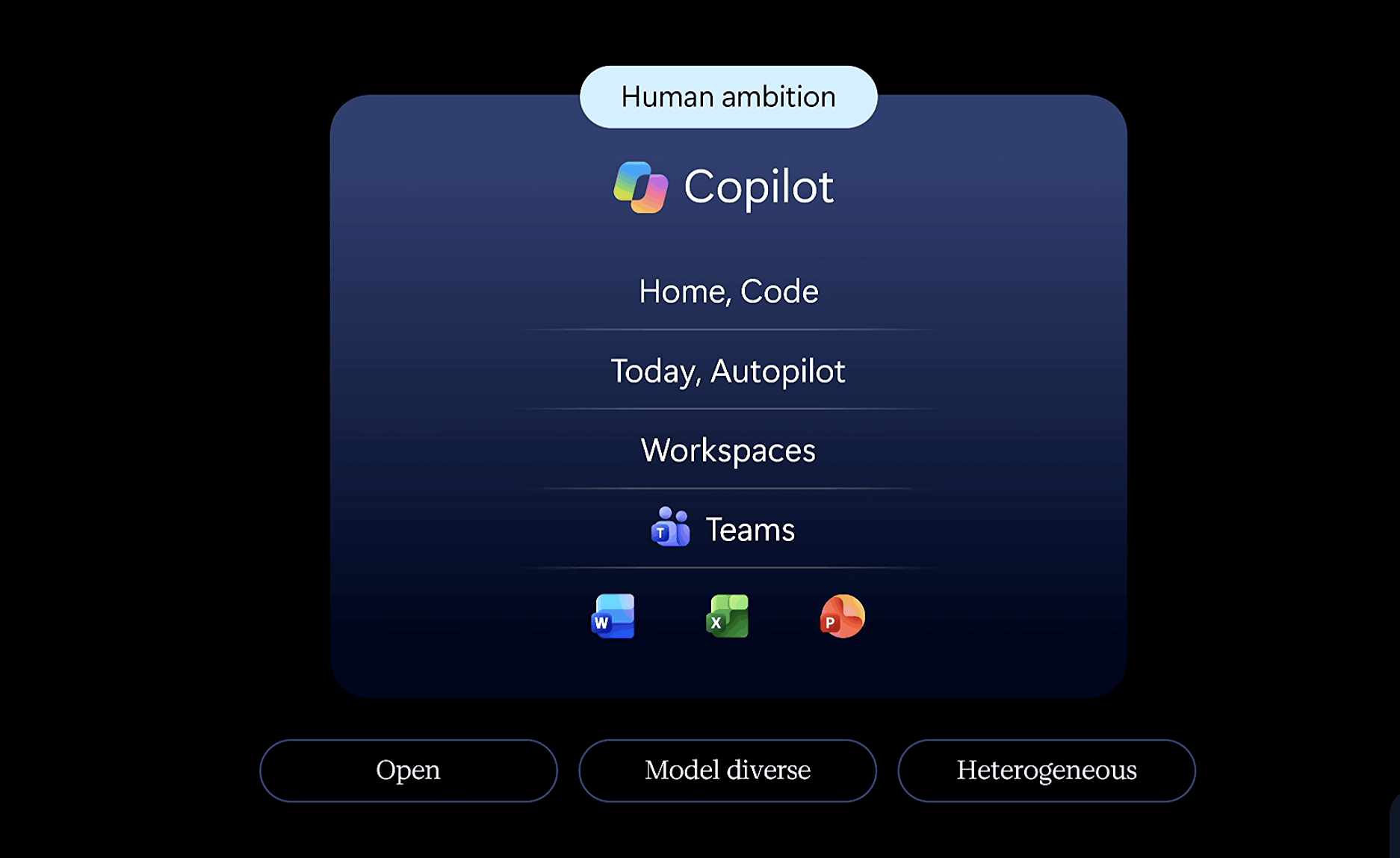
Microsoft’s Copilot direction moves AI from isolated assistance towards sustained participation in business workflows.
The objective is to increase human capability without surrendering human control.
That distinction matters. Human oversight should not become a ceremonial approval placed at the end of an otherwise opaque process. It should be designed around the decisions where judgement, accountability or risk make intervention meaningful.
Organisational Intelligence: The Value Is in the Context
Microsoft IQ was one of the keynote’s most strategically important announcements because it addresses a persistent limitation of enterprise AI. General intelligence may make a model capable, but organisational context makes it useful.
Microsoft IQ brings together several connected capabilities:
-
Work IQ provides context around how employees work, collaborate and make decisions.
-
Fabric IQ connects operational information, business data and the meaning behind organisational metrics.
-
Foundry IQ helps applications and agents access relevant knowledge from documents and other unstructured information.
-
Web IQ brings external and real-world information into the wider intelligence environment.
-
Third-party IQ extends this approach to information held in external business systems.
Microsoft also announced more than 350 third-party IQ connectors, expanding the ways in which organisational knowledge can be used across applications.
Taken together, these capabilities point towards a connected knowledge layer that can make agents more relevant to the organisation using them. An agent that understands internal terminology, business processes, customer relationships and existing decisions can provide more useful support than one operating solely from a general model.
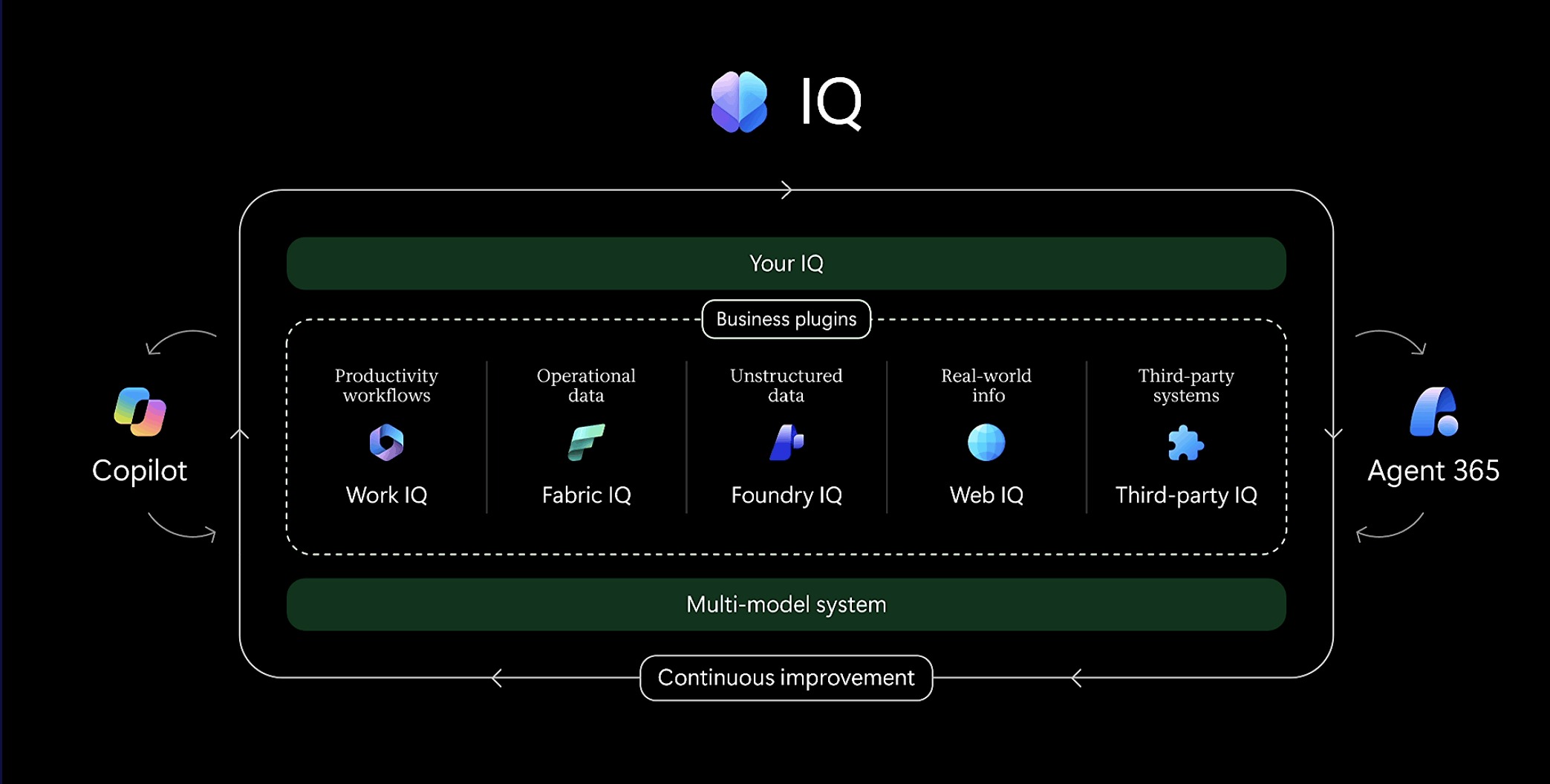
Microsoft IQ is intended to connect organisational knowledge so that Copilot and agents can operate with relevant business context.
This also makes information management a more important part of AI strategy. An agent can retrieve poor-quality data faster, distribute outdated knowledge more widely or expose information through permissions that were already too broad. AI does not remove existing information-governance weaknesses. It can amplify them.
Organisations therefore need to ask who owns the information being used, whether it remains accurate and which identities should be able to retrieve it. Classification, retention, access controls and data loss prevention become part of the AI value case because they determine whether organisational intelligence can be used safely and reliably.
There is also an ownership question. The knowledge embedded in documents, processes, customer relationships and employee expertise is a strategic business asset. It should remain governed by the organisation rather than becoming fragmented across disconnected applications, agents and services.
The strongest AI strategy will not begin with model selection. It will begin with a clear understanding of which knowledge creates value, where that knowledge resides and what must change before agents can use it responsibly.
Microsoft Agent 365: Bringing AI Agents Under Organisational Control
As AI agents spread across departments and business processes, organisations need the same clarity over their agent estate that they expect across users, applications and devices. Microsoft Agent 365 provides a management and governance layer designed to help organisations understand where agents are deployed, what they can access, who owns them and whether they remain appropriate for their intended purpose.
At Ignite, Microsoft announced expanded capabilities including:
-
Centralised discovery and inventories of AI agents
-
Improved monitoring of agent activity and performance
-
Governance of agent plugins, skills and connected tools
-
Identification of inactive agents and agents without clear ownership
-
Greater visibility into locally deployed and unsanctioned agents
-
Expanded risk assessments informed by security telemetry
New controls also extend governance to Model Context Protocol (MCP) servers, which allow agents to interact with external tools and business systems. This becomes increasingly important as agents gain access to more data and capabilities because effective governance needs to account not only for the agent itself, but also for the systems it can reach and the actions it can perform.
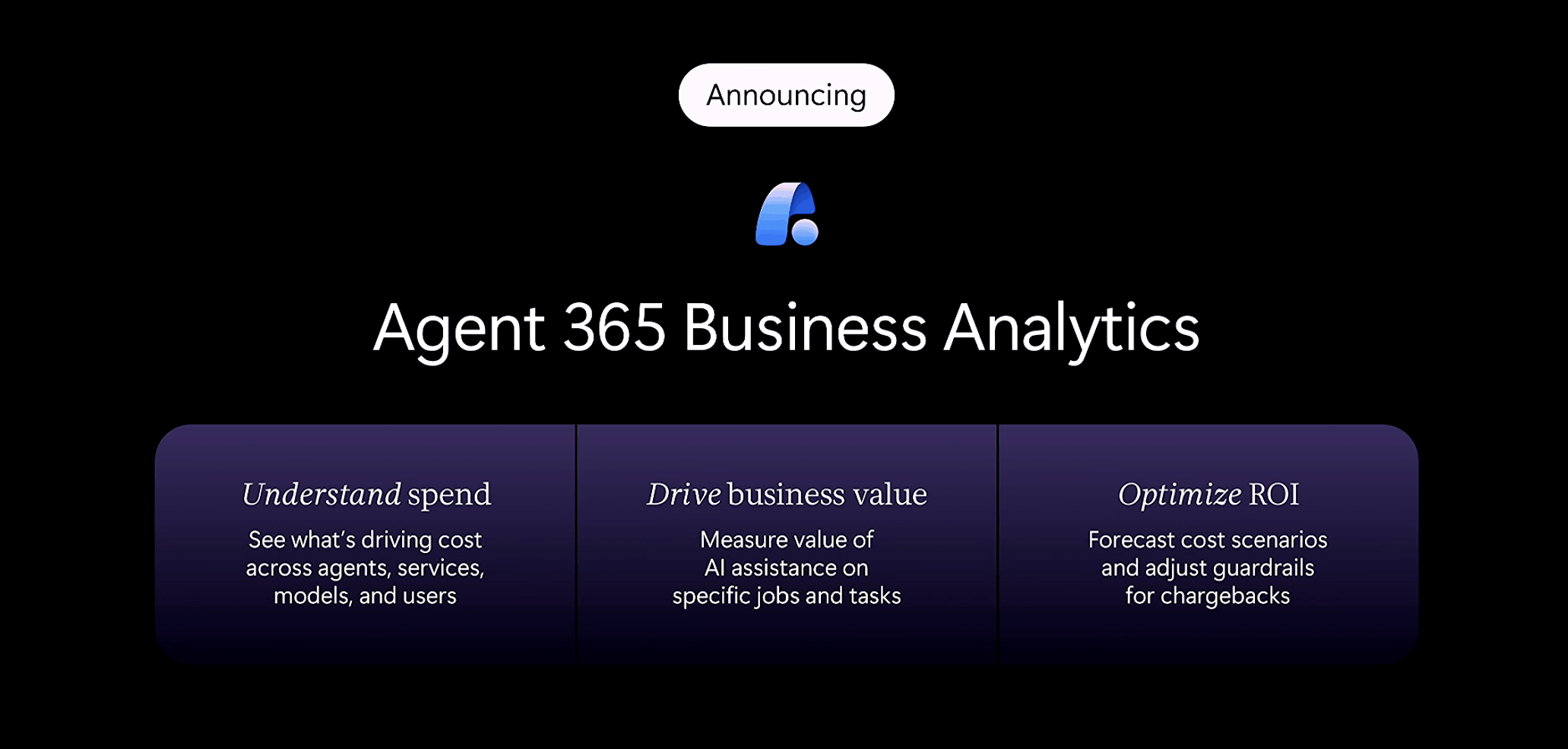
Agent 365 Business Analytics slide showing three capabilities: understanding AI spend across agents, services, models and users; measuring business value from AI-assisted work; and optimising ROI through cost forecasting and spending guardrails.
Agent 365 Business Analytics: Connecting AI Investment to Business Value
Governance addresses whether organisations can maintain control over their agents. Agent 365 Business Analytics addresses an equally important leadership question: whether that growing AI estate is generating sufficient value to justify continued investment.
The platform is designed to give organisations greater visibility across three commercial areas:
-
What Are We Spending? Understand AI expenditure across agents, services, models and users.
-
What Business Value Are We Generating? Evaluate how AI contributes to specific jobs and tasks using measures such as task success, user satisfaction and time assisted.
-
How Can We Optimise Our Investment? Forecast future expenditure, identify opportunities for improvement and introduce appropriate spending controls.
Microsoft also demonstrated cost-management capabilities that allow administrators to create spending policies, define limits, receive alerts and monitor usage. For business leaders, this moves the conversation beyond how many agents an organisation has deployed towards a more useful measure: whether those agents are delivering sufficient operational and commercial value to justify the investment.
Microsoft Foundry: Managing AI from Development to Production
Microsoft Foundry received significant updates focused on helping organisations develop, evaluate and operate AI applications and agents across a more controlled lifecycle. As enterprise adoption matures, the important question is no longer simply whether a model can perform a task, but whether the wider AI system continues to perform reliably once connected to business data, tools and production workflows.
New capabilities announced at Ignite include:
-
Agent evaluation to assess performance against defined requirements
-
Optimisation capabilities to improve agents and applications over time
-
Training capabilities to adapt AI systems to specific requirements
-
Expanded production monitoring to provide greater visibility after deployment
Microsoft also highlighted specialised models including Microsoft-Decision-1.1 and MAI-Cyber-2, alongside the GPT-6.2 model family within Foundry. Together, these announcements expand the model choices available to organisations developing AI-powered applications, allowing teams to consider different models according to the requirements of individual workloads.
The wider significance is the move towards treating enterprise AI as a lifecycle rather than a one-off deployment. Testing before release remains essential, but production environments introduce changing data, new integrations, evolving business requirements and security risks that may not be apparent during development.
Microsoft’s wider security research reinforces this approach, calling for continuous evaluation, testing, red teaming, governance and post-deployment monitoring across the AI lifecycle.
Trust: The Control Plane for an Agentic Organisation
The more authority an agent receives, the more important trust becomes. Organisations need to know that an agent is legitimate, that its access is appropriate and that its actions remain aligned with a defined business purpose.
This creates a new identity and governance challenge. Agents are not simply another category of conventional application. They can reason over information, call tools, retain context and initiate actions. Their permissions may also evolve as new skills or connections are added.
The Microsoft Digital Defense Report 2026 makes this requirement explicit. It argues that every agent needs a distinct identity rather than credentials borrowed from an employee. It also recommends human sponsorship, least-privilege access, automated lifecycle management, authentication between agents and short-lived credentials scoped to individual tools.
These are practical operating requirements. Without a current inventory, an organisation may not know which agents are active or what they can reach. Without a human sponsor, accountability becomes unclear when an agent behaves unexpectedly. Without lifecycle controls, permissions can remain in place after the agent’s original purpose has changed.
Identity is therefore becoming the control plane for an agentic organisation. Microsoft Entra has an important role in extending identity governance beyond employees and administrators to applications, workloads and AI agents. The objective is not to restrict all autonomous action. It is to make autonomy attributable, reviewable and revocable.
Organisations preparing to move from unmanaged experimentation to governed deployment can use CyberOne’s Microsoft Agent 365 Deployment service to assess their agent estate, establish ownership, design access controls and develop a practical lifecycle-governance model.
Microsoft Perception: A Major Evolution in Security Operations
One of Ignite’s most significant security announcements is the general availability of Microsoft Perception. Microsoft Perception brings together specialised AI security agents that collaborate through coordinated workflows called playbooks.
The platform introduces three complementary teams.
Red Team: Simulate Attacks
Red team agents assess security weaknesses from an attacker’s perspective. Their role is to identify vulnerabilities that could be exploited, assess attack paths and help organisations understand where their defences need strengthening.
Blue Team: Detect & Investigate
Blue team agents support threat detection, alert triage and investigation. They can analyse security signals across different systems and help security analysts understand suspicious activity.
This can reduce repetitive investigation work and help analysts focus on incidents requiring more complex judgement.
Green Team: Fix & Remediate
Green team agents help coordinate actions that reduce identified security risks. This includes prioritising vulnerabilities, recommending remediation and supporting security improvement workflows.
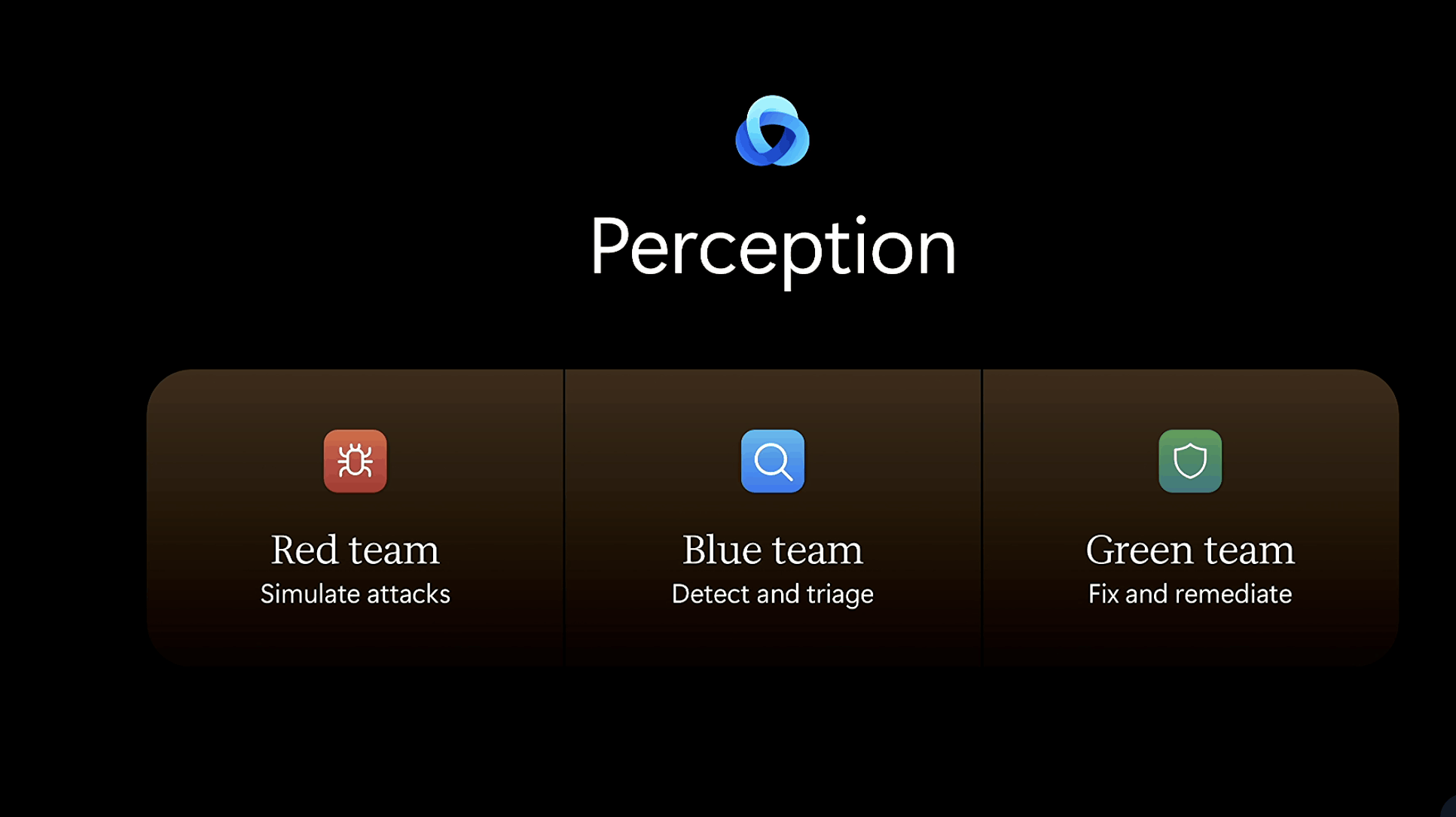
Perception brings red, blue and green team capabilities together to simulate attacks, detect and triage threats and support faster remediation.
Security Must Be Designed into the System
The security announcements at Microsoft Ignite 2026 reinforced a wider direction across Microsoft’s strategy: as AI becomes more deeply embedded in business operations, identity, data, endpoints, security operations and AI governance need to work as a connected system.
This matters because attackers rarely remain within one technical domain. An incident can begin with a compromised identity, move through an endpoint or cloud application and ultimately expose sensitive information. Investigating each event independently can obscure the relationship between apparently low-risk signals and slow the organisation’s ability to understand the wider attack.
Microsoft’s 2026 security research describes cross-signal correlation as one of the highest-leverage capabilities available to defenders. The value comes from connecting telemetry with threat intelligence and organisational context, giving security teams a clearer picture of what is happening and where action should be prioritised.
CyberOne’s analysis of Microsoft Sentinel for AI threat detection and strategic resilience explores this further, including the role of behavioural analytics, cross-signal correlation, detection engineering and experienced analysts in turning security telemetry into useful operational context.
For Microsoft customers, Ignite showed how that connected model is evolving across Microsoft Defender XDR, Microsoft Sentinel, Security Copilot, Microsoft Entra, Microsoft Purview, Microsoft Intune and emerging capabilities such as Project Perception. Each addresses a different part of the security problem, but greater value comes from how those capabilities work together.
From Individual Security Tasks to Coordinated Outcomes
The significance of Microsoft Perception is not simply the introduction of more security agents. It is the way specialised red, blue and green team capabilities can work together across a connected security workflow.
Red agents can simulate attacks and identify weaknesses, blue agents can investigate threats and assemble evidence and green agents can support remediation and security hardening. Microsoft has also introduced additional security agents across areas including threat intelligence, detection engineering, attack investigation and risk reduction.
This creates the potential for security teams to move more efficiently from identifying a weakness to understanding its relevance, prioritising remediation and measuring whether the resulting action has reduced risk. Rather than automating isolated tasks, the aim is to coordinate activity across different stages of security operations.
Potential operational improvements include:
-
Accelerated alert triage and investigation
-
Less repetitive security operations activity
-
Better identification and prioritisation of critical vulnerabilities
-
More consistent coordination between detection and remediation
-
Greater visibility across different security technologies
-
More time for analysts to focus on higher-value investigation and decision-making
Importantly, Perception supports approval controls around consequential actions. Human involvement therefore remains part of the operating model, but organisations still need to determine where approval is required, who has authority to provide it and who remains accountable for the outcome.
The objective is not automation for its own sake. It is to reduce operational friction while preserving meaningful human judgement around security decisions that carry material consequences.
Microsoft Defender & Sentinel: Building a More Integrated Security Operations Centre
Microsoft also announced further developments across Defender and Sentinel as part of its move towards a more integrated security operations model.
Microsoft’s Integrated Security Operations Center (ISOC) brings security analytics, threat intelligence, detection and response capabilities into a more connected Defender experience. The distinction between the technologies remains important. Microsoft Defender XDR provides threat protection and correlation across security domains, while Microsoft Sentinel provides SIEM capabilities and broader security data visibility. Perception adds specialised AI agents and coordinated workflows across that foundation.
For security teams, the intended value comes from connecting those capabilities rather than assessing each product in isolation. Endpoint, identity, cloud, email and application activity can form different stages of the same attack. Bringing more of that context together can help analysts understand relationships between events, prioritise incidents and coordinate investigation and response more consistently.
Technology integration alone, however, does not create an effective security operation. Organisations still need appropriate telemetry, meaningful detections, tested response processes and experienced people capable of interpreting risk.
For organisations that do not have the internal capability or coverage to sustain this continuously, CyberOne’s Managed SOC and MDR service combines Microsoft Sentinel with 24x7 monitoring, threat intelligence, detection engineering, investigation and response.
The direction is towards a security operations model where signals, context, people and agents work within the same operating environment. Automation can accelerate that model but it cannot compensate for fragmented visibility or weak operational foundations.
Microsoft Entra: Governing Identity for People & AI Agents
Identity remains one of the foundations of cyber security, but the population requiring an identity is changing. Organisations increasingly need to govern employees, administrators, applications, workloads and AI agents within the same security model.
Microsoft announced further developments across Entra including expanded agent discovery, access governance and identity resilience. Microsoft Entra Agent ID extends identity controls to agents interacting with organisational systems, giving security teams a clearer basis for understanding which agents exist, who owns them and what resources they can access.
Microsoft is also developing more dynamic approaches to permissions. Instead of providing persistent access because an agent operates on behalf of a highly privileged employee, access can be aligned more closely with the specific activity the agent needs to complete.
This principle becomes increasingly important as autonomy expands:
-
Give every agent an identifiable and auditable identity
-
Assign clear human ownership
-
Limit access to the resources required for its role
-
Apply more precise policies to sensitive activities
-
Monitor privileged and unusual activity
-
Review and revoke permissions that are no longer required
-
Maintain identity resilience and recovery capabilities
Consider an agent supporting a finance team with monthly reporting. Access to defined financial information may be necessary to complete the task. Unrestricted access to every system available to the supervising employee is not.
Microsoft’s wider security research reinforces this approach, recommending distinct agent identities, human sponsors, least-privilege access and lifecycle governance. The aim is to make autonomous access attributable, appropriately scoped and revocable.
AI agents should operate with the permissions necessary for their assigned tasks, not unrestricted access inherited from users.
Microsoft Purview: Protecting the Data That Powers AI
AI applications become more useful when they can draw on relevant organisational information. That same access makes data governance increasingly important because Copilot and AI agents can make existing information easier to discover, combine and use.
Microsoft announced further developments across Purview covering automated classification, sensitivity labelling and data loss prevention. New controls are also designed to protect information used to ground Microsoft Copilot responses, including policies based on sensitive information types and expanded protection for AI prompts and supported local agents.
For many organisations, the underlying challenge already exists. Sensitive information may be distributed across SharePoint, Teams, OneDrive, email and business applications while legacy permissions give more people access than their role requires. Introducing AI into that environment can make an existing governance problem more consequential.
A stronger data-security foundation should therefore include:
-
Identifying and classifying sensitive information
-
Reviewing ownership and access permissions
-
Applying consistent sensitivity and protection policies
-
Monitoring how sensitive information is used by AI
-
Reducing inappropriate or unnecessary exposure
-
Maintaining retention and compliance requirements as AI adoption expands
Purview provides important technical capabilities, but AI-specific protection does not compensate for weak information governance. Organisations still need to understand what information they hold, why they retain it and who should legitimately be able to use it.
The objective is to make relevant business information available to AI without making sensitive information available to an unintended audience.
Microsoft Intune & Defender for Endpoint: Extending AI Governance to Devices
AI governance is also moving closer to the endpoint. Local agents can interact with files, applications, connected services and operating system resources, creating a different security challenge from AI services operating entirely in the cloud.
Microsoft announced expanded capabilities across Intune and Defender for Endpoint to help organisations discover, monitor and govern supported local AI agents. These controls are intended to give administrators greater visibility into which agents are operating on managed devices and how those agents interact with the wider environment.
The announcements also include protections intended to identify malicious instructions embedded in content processed by AI systems. Prompt injection attacks attempt to manipulate AI into following unintended instructions, which becomes more consequential when an agent can access business data, invoke tools or execute actions.
Endpoint controls can therefore contribute to a wider agent-governance strategy by helping organisations:
-
Discover local AI agents on managed devices
-
Identify unapproved or potentially risky applications
-
Apply policies governing supported agent behaviour
-
Protect sensitive business information
-
Strengthen isolation and network controls
-
Limit the potential impact of a compromised agent
This becomes particularly relevant as organisations move from tightly controlled AI pilots towards wider deployment. Security teams will need visibility across both cloud services and the capable agents operating closer to users and devices.
Vulnerability Shielding & Continuous Risk Reduction
Microsoft is also developing capabilities intended to shorten the distance between identifying an exploitable weakness and reducing the associated risk.
Vulnerability Shielding, currently in preview, is designed to provide targeted temporary protections where immediate patching is not practical. This can give security and IT teams another mitigation option while permanent remediation is tested and deployed.
Microsoft Perception’s AI Readiness Initiatives, scheduled for preview in January 2027, extend this idea by translating security recommendations into structured improvement programmes. Initial areas include vulnerability management, authentication and AI agent governance.
The strategic shift is away from treating vulnerability management as a sequence of isolated findings and towards a continuous risk-reduction process. Identifying a vulnerability remains important, but organisations also need to establish:
-
Whether the vulnerability is realistically exploitable
-
Which business systems could be affected
-
What interim protection is appropriate
-
Which remediation should be prioritised
-
Whether corrective action reduced the intended risk
Temporary shielding should not become a substitute for patching. Its value lies in reducing exposure when immediate remediation is not operationally practical, while teams work towards a permanent fix.
Secure Development: MDASH & AI-Powered Security Testing
AI is accelerating software development, which means application security needs to become faster without sacrificing assurance.
Microsoft’s MDASH initiative applies specialised agents to software security testing, helping identify, assess and validate potential vulnerabilities across software repositories. Currently available in preview to eligible organisations, the approach is intended to improve the quality of findings and help developers distinguish meaningful security issues from lower-value noise.
Microsoft is also developing specialised cyber security AI models through the MAI-Cyber family to support security analysis. The significant change is not simply that AI can identify more potential vulnerabilities. It is the possibility of using specialised models and agents to test software more continuously as development accelerates.
AI-assisted security testing should nevertheless remain part of a wider secure-development model that includes:
-
Secure-by-design development standards
-
Validation of AI-generated findings
-
Expert review of meaningful vulnerabilities
-
Independent security assurance where appropriate
-
Penetration testing for relevant applications and environments
-
Clear ownership of remediation
Faster vulnerability discovery has limited value if teams cannot determine which findings matter, remediate them safely or confirm that the underlying weakness has been addressed.
Microsoft’s AI Transparency Initiative: Making AI Actions Verifiable
As AI agents gain greater autonomy, organisations will need stronger evidence of what those systems were authorised to do and what actually happened when they acted.
Microsoft’s AI Transparency Initiative focuses on increasing visibility into AI behaviour and making AI-driven actions easier to verify independently. The underlying principle is important for enterprise adoption: governance cannot depend solely on knowing that an AI system was approved for use.
Organisations increasingly need evidence showing what authority an agent had, which information and tools it used and how an important outcome was produced.
Greater transparency can support:
-
Clearer accountability for AI-driven activities
-
Stronger audit and assurance processes
-
More effective governance of autonomous actions
-
Greater scrutiny of third-party AI systems
This becomes particularly relevant in regulated environments, where organisations may need to reconstruct or evidence an important action long after the AI interaction occurred.
Transparency should therefore become part of AI architecture, procurement and governance from the outset rather than a control added after systems are already operating.
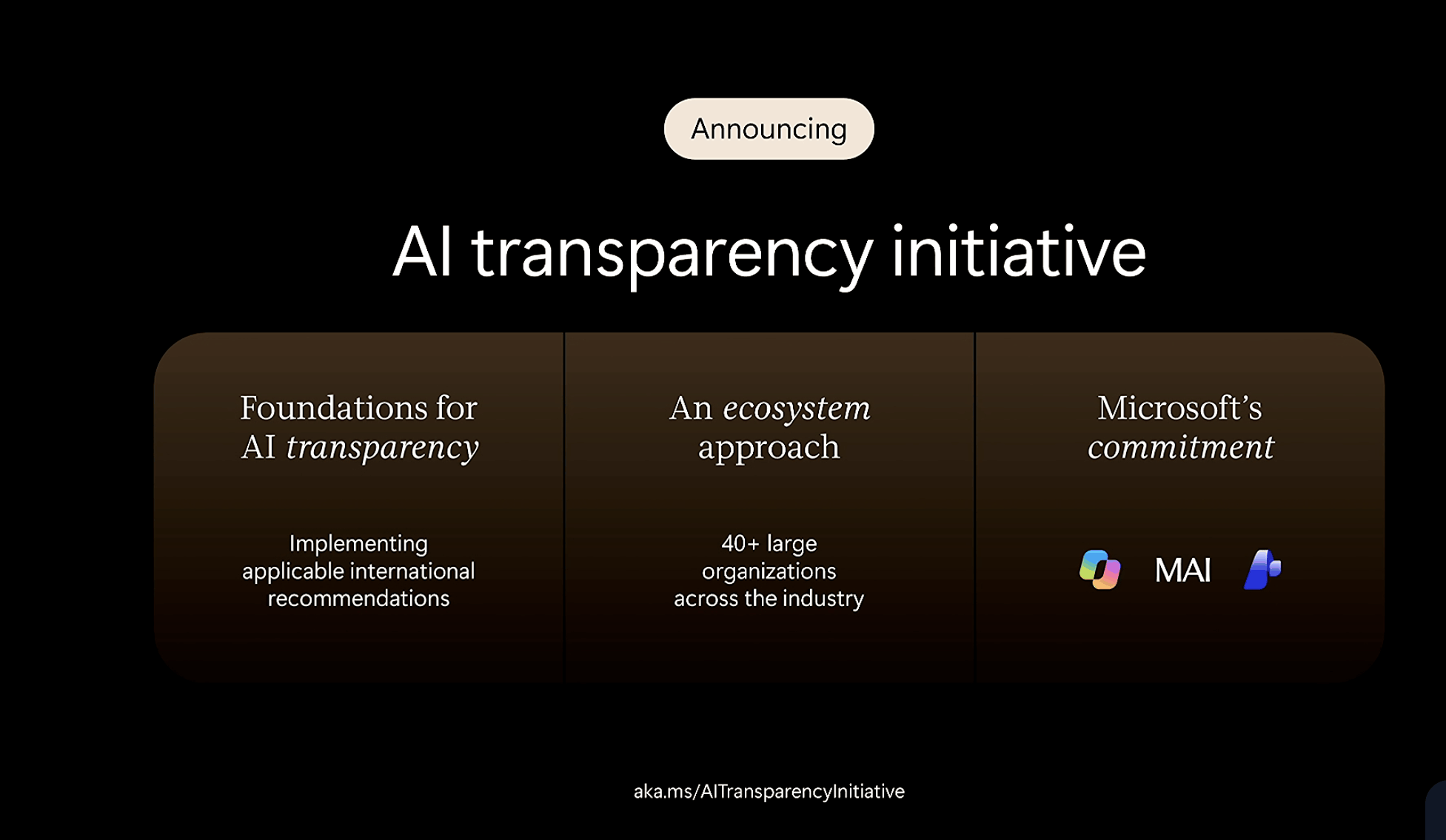
Microsoft’s AI Transparency Initiative combines international recommendations, industry collaboration and Microsoft commitments to strengthen transparency as AI systems become more widely deployed.
Secure AI Is an Operating Model, Not a Product Decision
Microsoft Ignite 2026 presented an ambitious technology roadmap, but its more important message was organisational. AI value will not come from deploying the greatest number of agents or adopting every announced feature. It will come from redesigning selected workflows, connecting trustworthy organisational knowledge and maintaining effective control over every identity and action.
Microsoft is bringing together the platform capabilities needed to support that approach across Copilot, Microsoft IQ, Agent 365, Azure and Microsoft Security. Realising their value still requires organisations to address architecture, data quality, identity governance, security operations and accountability as connected priorities.
The most credible path is to begin with a small number of valuable use cases, assess the data and access they require, establish ownership and validate the controls before expanding. That approach does not slow innovation. It creates the conditions in which innovation can scale without outrunning the organisation’s ability to govern it.
AI innovation and cyber resilience must advance together. That is how organisations can move from experimentation to measurable value while preserving the trust on which intelligent business depends.
Join Our Microsoft Ignite 2026 Unpacked Webinar
On their return home from San Francisco, Luke Elston and Ben Harding explore the most important announcements, explain the technical developments and discuss what they mean for organisations planning their next steps.