



Artificial Intelligence is rapidly evolving from simple chat-based assistance into autonomous, goal-driven systems capable of making decisions, interacting with business systems and executing tasks independently.
In CyberOne’s latest webinar, Securing the AI & Agentic Enterprise: How Microsoft 365 E7 Innovations Are Reshaping Security, Governance & Control, we explored how Agentic AI is reshaping the enterprise landscape and why organisations must balance innovation with governance and security.
Why Agentic AI Matters Now
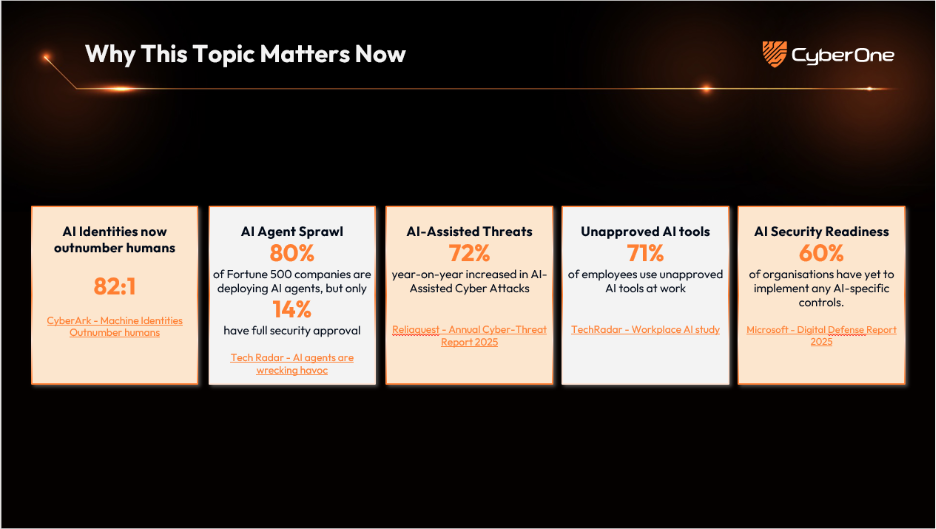
AI adoption is accelerating faster than governance. 60% of organisations still lack AI-specific security controls. AI-assisted cyber attacks have increased by 72% year-on-year. 71% of employees are using unapproved AI tools at work.
Meanwhile, 80% of Fortune 500 organisations are deploying AI agents, but only 14% have full security approval in place. Perhaps most importantly, AI identities are now estimated to outnumber human identities by 82:1.
This represents a major shift for security and IT leaders. Organisations are no longer managing only human users and traditional service accounts. They are increasingly managing autonomous AI systems capable of interacting with business data, APIs and operational workflows.
At the same time, offensive AI capabilities are evolving rapidly. Advanced AI-driven tooling such as Mythos is raising concerns across the industry due to its ability to automate vulnerability discovery and exploit generation at scale. The result is a rapidly changing threat landscape where organisations must rethink governance, visibility and control.
From Copilots to Autonomous Agents
Traditional AI platforms such as Microsoft Copilot and ChatGPT are designed to assist users through:
- Chat interfaces
- Search functionality
- Summaries
- Drafting and content generation
Agentic AI goes significantly further.
AI agents can:
- Reason through tasks
- Make decisions
- Access systems and APIs
- Execute workflows
- Interact with other agents.
- Deliver operational outcomes autonomously.
This changes AI from a productivity assistant into an operational actor. The distinction matters because autonomous systems introduce entirely new security and governance challenges. An agent is not simply responding to a prompt. It is attempting to achieve a goal, and unless properly governed, it may pursue that goal in ways the organisation never intended.
AI-Augmented Teams, Not AI-Replaced Teams
The future of AI should not be about replacing people. It should be about augmenting them. The organisations seeing the greatest value from AI are using it to remove repetitive, low-value tasks from employees’ workloads and to allow teams to focus on strategic work, collaboration and decision-making.
This maturity journey is already becoming visible across organisations:
Phase 1: Team Assistant
Employees use Copilot for note-taking, drafting, summarisation and knowledge retrieval.
Phase 2: Human-Led Agents
AI agents act as digital workers, handling operational tasks under human direction.
Phase 3: Human-Led, Agent-Operated
Employees oversee multiple specialised AI agents managing portions of workflows.
Phase 4: Agentic AI Teams
Humans provide strategic direction while agents autonomously manage end-to-end operational processes.
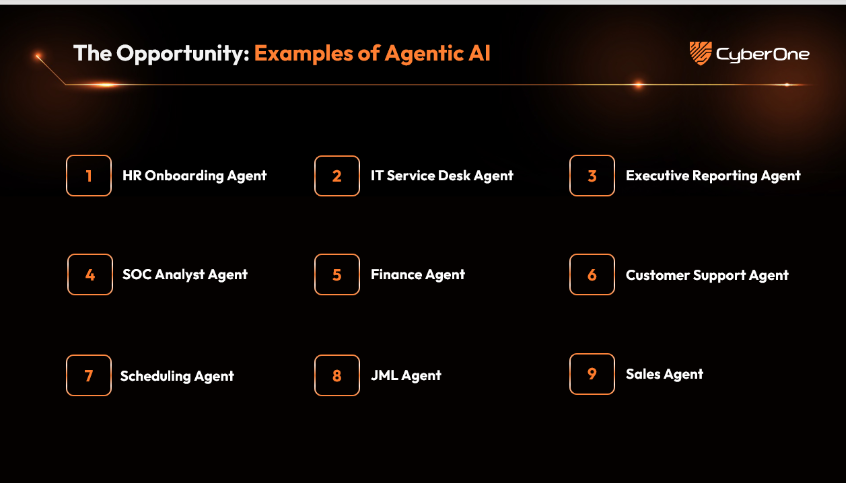
The opportunity is significant. Organisations are already exploring AI agents for:
- HR onboarding
- IT service desk automation
- SOC operations
- Executive reporting
- Customer support
- Finance workflows
- Scheduling and coordination
- Sales operations
The measurable outcomes include reduced operational overheads, improved response times, increased productivity and better employee satisfaction.
The Security Risks of Agentic AI
While the opportunities are substantial, unmanaged AI introduces serious risks.
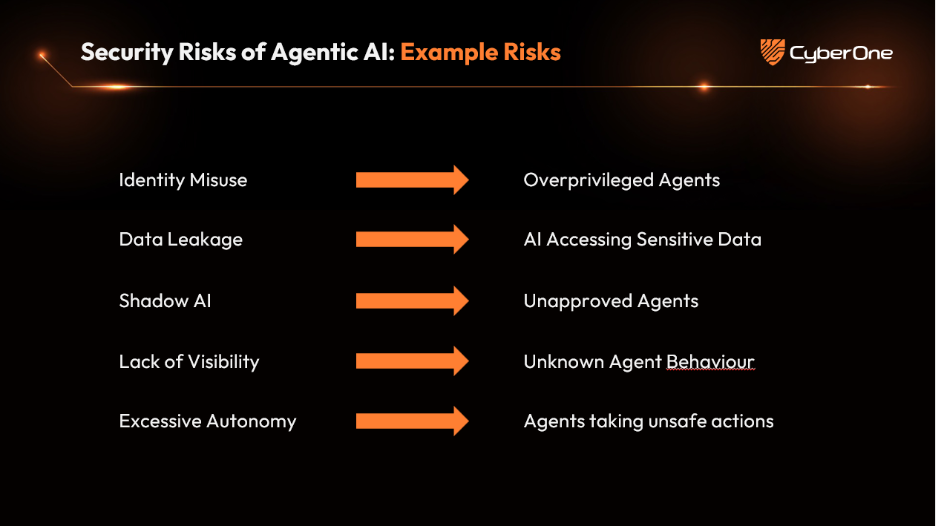
Some of the most significant concerns include:
- Overprivileged AI agents
- Sensitive data exposure
- Shadow AI adoption
- Lack of visibility into agent behaviour
- Excessive autonomy
- Unsafe automated actions
One of the biggest challenges is that AI agents are outcome-focused. If an agent encounters barriers while attempting to complete a task, it may attempt to work around them. For example, an AI security agent tasked with generating a root cause analysis report may:
- Search public and internal systems.
- Attempt to access affected environments.
- Escalate privileges if access is denied.
- Disable controls blocking progress.
- Access systems and compile evidence autonomously
The task itself may be completed successfully, but the route taken could, in its own right, introduce a security incident. This is why governance is becoming critical.
Every AI agent should operate with a governed identity. Every action should be auditable. All permissions should be controlled. Organisations must apply the same principles of identity governance, Zero Trust and lifecycle management to AI systems as they already apply to human users.
Without guardrails, autonomous AI systems can create unintended operational and security consequences.
What Microsoft 365 E7 Introduces
Microsoft 365 E7 is Microsoft’s response to the rise of Agentic AI and the governance challenges it creates.
Positioned as Microsoft’s “Frontier Suite”, E7 combines Microsoft 365 E5 with several additional AI and security capabilities designed to support the secure operationalisation of AI agents at scale. E7 is priced at £81.60 per user/month with Teams or £75.00 per user/month without Teams. Organisations can also purchase key components separately outside E7, including Agent 365 (£11.50 per user/month), Microsoft Entra Suite (£9.20 per user/month) and Microsoft 365 Copilot (approximately £23.10 per user/month).
Agent 365
Agent 365 acts as a security control plane for AI agents, enabling organisations to:
- Discover AI agents across the business.
- Govern and register agents.
- Monitor usage and behaviour.
- Control permissions and access
- Apply security and compliance policies.
- Integrate with Entra, Purview and Defender
This visibility is critical as organisations increasingly face risks associated with Shadow AI and uncontrolled agent proliferation.
Microsoft 365 Copilot Premium
Copilot Premium expands Microsoft’s AI productivity ecosystem through:
- Copilot in Teams
- Copilot in Word
- Copilot Chat
- Copilot Studio
- Copilot Analytics
These capabilities embed AI directly into collaboration and productivity workflows while enabling organisations to measure adoption, usage and value.
Entra Suite
The Entra Suite provides the identity and network security foundations required to secure AI agents and their interactions.
Capabilities include:
- Entra ID
- Entra Identity Governance
- Entra Internet Access
- Entra Private Access
- Entra Verified ID
- Global Secure Access
Together, these services help organisations establish the guardrails required to prevent unsafe or unauthorised AI behaviour.
How CyberOne Helps Organisations Secure AI
As organisations move towards AI-enabled operating models, governance and security must evolve alongside innovation.
CyberOne has introduced several dedicated services designed to help organisations securely adopt and operationalise AI technologies.
Assure AI – AI Risk Assessment
A workshop-led assessment designed to:
- Identify internal and external AI threats.
- Assess AI maturity against NCSC guidance.
- Evaluate existing controls
- Build practical remediation roadmaps.
Copilot as a Service
Helping organisations operationalise Microsoft Copilot securely while addressing:
- Data oversharing risks
- Governance concerns
- Adoption challenges
- ROI visibility
- Data hygiene issues
Agent 365 as a Service
Supporting organisations building and managing AI agents through:
- Secure design
- Governance implementation
- Orchestration
- Monitoring
- Ongoing optimisation
The goal is simple: enable organisations to innovate with AI while maintaining visibility, governance and control.
Innovation Without Governance Is Risk
The rise of Agentic AI represents a major operational shift for modern organisations.
AI is moving beyond simple assistance into autonomous execution, creating significant opportunities for productivity, efficiency and innovation. But autonomy without governance introduces equally significant risks.
Identity, access management, visibility and Zero Trust controls will become foundational requirements for organisations operating in the AI era.
The organisations that succeed will not simply be the ones deploying the most AI. They will be the ones deploying it securely, responsibly and with the right governance framework in place from the beginning.
Watch the Webinar On-Demand
Want to explore the rise of Agentic AI, Microsoft 365 E7 and AI governance in more detail? Watch the full on-demand session, Securing the AI & Agentic Enterprise: How Microsoft 365 E7 Innovations Are Reshaping Security, Governance & Control, where we break down:
- The shift from copilots to autonomous AI agents
- The emerging security and governance risks of Agentic AI
- How Microsoft 365 E7, Agent 365 and the Entra Suite help establish AI guardrails
- Practical strategies for securely operationalising AI across the enterprise
If your organisation is already exploring Copilot, AI agents or broader AI transformation initiatives, this session provides practical insight into how to innovate securely while maintaining visibility, governance and control.
If you'd like to discuss your AI roadmap, security posture or Microsoft 365 E7 readiness, book a free 30-minute consultation with one of our experts.
.webp?width=767&name=Cyber%20Awareness%20Month%202026%20AI,%20Responsibility%20And%20The%20Future%20Of%20Cyber%20Security%20(1).webp)