



Security teams are surrounded by data from endpoints, identities, cloud services, email, applications and networks. Yet collecting more signals does not guarantee clearer visibility or faster, better decisions.
The real challenge is turning disconnected signals into actionable insight. Analysts need to know which threats matter, how they could impact the organisation and which actions to prioritise. This is where Threat Intelligence proves its value.
Effective Cyber Threat Intelligence turns raw data into context that security teams can use. It helps organisations spot emerging risks, strengthen threat detection, guide threat hunting and give analysts the clarity they need to investigate incidents with confidence.
Intelligence only delivers value when it is integrated into day-to-day security operations. Simply subscribing to more data sources is not enough. Organisations need clear intelligence requirements, relevant Threat Intelligence Feeds, repeatable processes and integration with the technology their security teams already use.
This guide sets out how organisations can collect, analyse and operationalise intelligence. It also shows how Microsoft Defender Threat Intelligence and Microsoft Sentinel Threat Intelligence support a more informed, proactive and resilient approach to cyber security.
What Is Threat Intelligence?
Threat Intelligence is evidence-based knowledge about existing or potential cyber threats. It helps organisations understand risk and make better-informed security decisions.
Intelligence may provide insight into:
- Threat actors and their likely objectives
- Malicious infrastructure
- Attack techniques and behaviours
- Active or emerging campaigns
- Vulnerabilities being targeted
- Indicators associated with compromise
Raw threat data alone is not intelligence. An IP address, file hash or domain may suggest suspicious activity, but without context, its value is limited.
Security teams also need to know:
- Where the indicator came from
- How recently it was observed
- Whether it is relevant to their environment
- Which technologies or sectors it affects
- How reliable the source is
- What action the organisation should consider
This context transforms an isolated security indicator into actionable insight for analysts.
Why Does Cyber Threat Intelligence Matter?
Security teams operate across complex technology environments, managing alerts, vulnerabilities and live incidents. With limited resources, effective prioritisation is essential.
Strong Cyber Threat Intelligence helps teams focus on the threats most relevant to their organisation. It supports:
- Earlier identification of relevant threats
- Better prioritisation of alerts and vulnerabilities
- Faster, more consistent investigations
- More focused defensive improvements
- Clearer communication between security and business leaders
- More informed security investment decisions
The goal is not to predict every possible attack. Intelligence reduces uncertainty and helps decision-makers allocate time, skills and technology based on relevance, exposure and potential business impact.
Data, Information and Intelligence: What Is the Difference?
Understanding the difference between data, information and intelligence is essential for building an effective programme.
Data
Data consists of raw observations. Examples include:
- IP addresses
- Domain names
- File hashes
- Authentication events
- Endpoint alerts
- Network connections
A single data point may be useful, but it rarely provides enough context to support a decision.
Information
Information is data that has been organised, validated or enriched.
For example, a security team may establish that an IP address has communicated with infrastructure associated with malicious activity. The original data now has additional meaning, but analysts may still need more context before taking action.
Intelligence
Intelligence combines information with analysis, relevance and recommended action.
Analysts might conclude that the infrastructure is associated with a campaign targeting the organisation’s sector. They could then recommend specific searches, control changes or response actions.
Data shows that something happened. Intelligence explains why it matters and what action the organisation should take next.
How Does the Threat Intelligence Lifecycle Work?
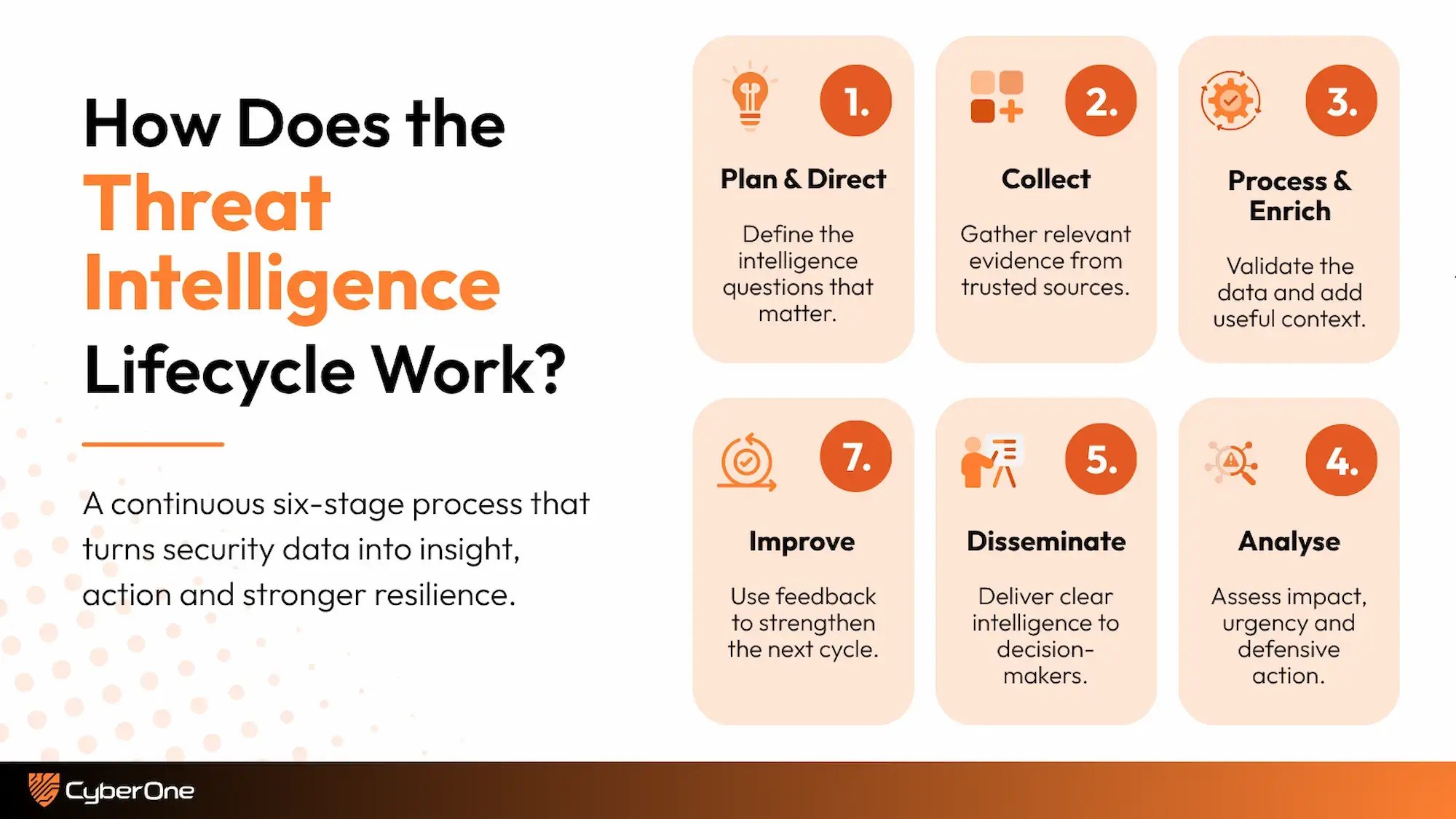
The Threat Intelligence Lifecycle is a repeatable process for turning security data into useful insight. It typically includes six stages: planning, collection, processing, analysis, dissemination and feedback.
1. Planning and Direction
The lifecycle begins with a clear understanding of what the organisation needs to know.
Security leaders should define specific intelligence requirements connected to business risks and operational decisions. These requirements might include:
- Which threat actors are targeting the organisation’s sector?
- Which vulnerabilities present the greatest immediate risk?
- What behaviour could indicate identity compromise?
- Which critical services are most exposed to disruption?
- What information do incident responders need during an investigation?
Clear requirements keep intelligence programmes focused and prevent them from becoming unfocused data-collection exercises.
2. Collection
The organisation then collects data from relevant internal and external sources.
Potential sources include:
- Endpoint, identity, email and network telemetry
- Vulnerability management platforms
- Previous incidents and investigations
- Open-source intelligence
- Commercial intelligence providers
- Government and vendor advisories
- Sector-specific sharing communities
- Threat Intelligence Feeds
Collection should align with the intelligence requirements set during planning. Gathering information with little connection to the organisation’s risks, systems or decisions only adds unnecessary noise.
3. Processing and Enrichment
Collected data often arrives in different formats and with varying levels of quality. Processing prepares it for analysis by normalising, validating, deduplicating and enriching the information.
Enrichment can add details such as:
- The age of an indicator
- Source reliability
- Confidence levels
- Geographic or sector relevance
- Associated malware or campaigns
- Affected technologies
- Known attack behaviours
This stage helps analysts separate meaningful signals from outdated, duplicated or irrelevant data.
4. Analysis
During analysis, security professionals assess the reliability, relevance and potential impact of the information.
Effective analysis should answer practical questions:
- Does this activity affect the organisation?
- Which assets, users or services are at risk?
- What could happen if the threat succeeds?
- How urgent is the issue?
- Which defensive action is appropriate?
- How confident are analysts in the assessment?
A useful intelligence assessment clearly distinguishes confirmed facts, assumptions and analyst judgement.
5. Dissemination
Intelligence must reach the people who can act on it, in a format suited to their responsibilities.
A SOC analyst may need indicators, confidence levels and investigation guidance. A vulnerability management team may need prioritised exposure information. Executives and board members may need a concise explanation of business risk, possible disruption and recommended action.
The same intelligence may need to be delivered in several different formats.
6. Feedback and Improvement
The final stage evaluates whether the intelligence met its original requirement and helped its audience make a decision.
Feedback may reveal that a report:
- Arrived too late
- Contained insufficient context
- Was too technical for its audience
- Did not recommend a clear action
- Duplicated information already available elsewhere
These lessons should inform the next intelligence cycle. The Threat Intelligence Lifecycle is a continuous improvement process, not a one-way flow of information.
What Are the Main Types of Threat Intelligence?
Intelligence serves different audiences and decision-making timescales. Most programmes organise it into four categories.
Strategic Intelligence
Strategic intelligence helps executives, security leaders and risk owners understand long-term developments.
It may examine:
- Changes in threat actor behaviour
- Geopolitical developments
- Sector targeting
- Regulatory implications
- Organisational exposure
- Capability and investment priorities
Its purpose is to support business risk decisions, shape security strategy and strengthen organisational resilience.
Operational Intelligence
Operational intelligence focuses on active or emerging campaigns. It helps teams understand who may be conducting an operation, which organisations are being targeted and how the activity is developing.
This insight can inform incident readiness and short-term defensive priorities.
Tactical Intelligence
Tactical intelligence examines the techniques and behaviours used by attackers.
It can help security teams understand how adversaries:
- Gain initial access
- Escalate privileges
- Move through an environment
- Evade security controls
- Access or remove information
- Disrupt business services
Teams use these insights to improve security analytics, strengthen controls and guide investigations.
Technical Intelligence
Technical intelligence includes observable indicators such as malicious domains, IP addresses, URLs and file hashes.
These indicators are often machine-readable and can support automated correlation or blocking. However, their value may decline quickly as attackers change their infrastructure.
Technical indicators are most valuable when combined with context, confidence levels and behavioural analysis.
Where Does Threat Intelligence Come From?
A mature programme combines external intelligence with the organisation’s own security telemetry.
Open-Source Intelligence
Open-source intelligence includes publicly available security research, advisories, vulnerability disclosures and community resources.
It is widely accessible, but quality and relevance can vary. Security teams should validate open-source material before using it to support important decisions.
Commercial Intelligence Providers
Commercial providers may supply:
- Curated indicators
- Adversary research
- Malware analysis
- Campaign reporting
- Sector-specific intelligence
Organisations should assess providers based on their intelligence requirements, not the volume of information offered.
Industry-Sharing Communities
Sector-specific communities allow organisations with similar technologies, risks or regulatory obligations to share relevant information.
This collaboration can help members recognise common attack patterns and prepare for activity observed elsewhere.
Internal Security Telemetry
Internal telemetry is especially valuable because it shows what is happening within the organisation’s own environment.
Useful sources may include:
- Identity and authentication events
- Endpoint activity
- Email security data
- Cloud logs
- Network telemetry
- Previous incident records
The greatest value comes from connecting external context with internal evidence.
Threat Intelligence Feeds Explained
Threat Intelligence Feeds are streams of data about potential or active cyber threats. They may include indicators of compromise, malicious infrastructure, vulnerabilities, malware campaigns and attacker behaviours.
Feeds can enrich alerts, support investigations and enable automated correlation. But subscribing to a feed does not guarantee better protection.
If the information is inaccurate, outdated or irrelevant, it increases alert volumes and consumes analysts’ time without reducing risk.
Why Quality Matters More Than Quantity
More sources can create duplicate indicators, conflicting assessments and unnecessary alert noise. Analysts may waste valuable time investigating information with little relevance to the organisation’s sector, systems or risk profile.
Security teams should assess feeds against criteria such as:
- Relevance to the organisation
- Accuracy and source reliability
- Timeliness
- Context and confidence
- Coverage of priority technologies
- Ease of integration
- Measurable operational value
The key question is not how much data the feed provides, but which security decision or action the data will improve.
Our article, The Truth About Threat Intelligence Feeds: Why Quality Beats Quantity, explores why low-quality feed overload can contribute to alert fatigue, slower incident response and weak returns on investment.
How Does Intelligence Improve Threat Detection?
Threat Detection is the process of identifying activity that may indicate malicious behaviour, compromise or a security policy violation.
Intelligence improves detection by adding context to otherwise isolated signals.
For example, unusual authentication activity may appear suspicious but inconclusive. If current intelligence connects the source infrastructure or observed behaviour with an active campaign, analysts have a stronger reason to investigate it promptly.
Intelligence can strengthen detection by:
- Enriching alerts with relevant context
- Identifying infrastructure associated with malicious activity
- Highlighting behaviours connected to known attack techniques
- Supporting the development of detection analytics
- Prioritising activity involving critical assets
- Improving escalation decisions
The aim is not to generate an alert for every available indicator, but to increase the relevance and quality of detections.
Organisations should measure whether intelligence improves outcomes. Useful metrics include investigation time, false-positive rates, detection coverage and the proportion of intelligence that leads to a control change, investigation or response action.
How Does Intelligence Support Threat Hunting?
Threat Hunting is a proactive search for suspicious behaviour that may not have triggered an existing alert.
Instead of waiting for a confirmed incident, analysts form a hypothesis and test it using security telemetry. Intelligence gives these hunts direction.
For example, analysts may use knowledge of an adversary’s behaviour to search for:
- Unusual authentication patterns
- Unexpected process relationships
- Suspicious administrative activity
- Communication with known malicious infrastructure
- Behaviour associated with lateral movement
An intelligence-led hunt typically follows a simple process:
- Select a relevant threat or behaviour.
- Develop a testable hypothesis.
- Identify the telemetry required.
- Search the environment.
- Investigate anomalies.
- Record the findings.
- Improve controls or detections.
Even when a hunt finds no compromise, it can reveal gaps in visibility, logging or analytics that need to be addressed.
Effective Threat Hunting contributes to continuous security improvement. It helps organisations test whether their controls can identify the behaviours that matter most.
Threat Intelligence for SOC Teams
The most valuable intelligence is intelligence that analysts can apply during monitoring, triage, investigation and response.
Threat Intelligence for SOC Teams must be timely, relevant and integrated into established workflows. Poorly operationalised intelligence becomes another source of noise, especially when analysts receive indicators without confidence levels or reports without a clear action.
Practical operationalisation can include:
- Enriching alerts with confidence and contextual information
- Mapping relevant intelligence to assets and identities
- Turning adversary behaviours into detection use cases
- Using intelligence to direct investigations and hunts
- Connecting intelligence with vulnerability prioritisation
- Capturing analyst feedback on source quality
- Recording which intelligence produced an operational outcome
How Should SOC Value Be Measured?
Threat Intelligence for SOC Teams should improve operational performance, not just increase information volume.
Relevant measures may include:
- Faster alert triage
- Less time spent investigating irrelevant indicators
- Better detection coverage for priority threats
- More focused hunting activity
- Faster escalation of genuine incidents
- More consistent investigation decisions
- More intelligence-led changes to controls
The most valuable measures connect technical performance to business outcomes. Faster identification and containment reduce the risk that a security event develops into wider operational disruption.
Threat Intelligence Across the Microsoft Security Ecosystem
Microsoft security technologies help organisations connect telemetry, intelligence, analytics and response workflows.
Technology alone does not create a mature intelligence capability. Organisations still need defined requirements, appropriate data, skilled analysis and processes that turn findings into action.
Microsoft Defender Threat Intelligence
Microsoft Defender Threat Intelligence can help security teams obtain context about adversaries, campaigns and malicious infrastructure.
This context can support:
- Investigation scoping
- Assessment of suspicious infrastructure
- Understanding of threat actor activity
- Prioritisation of emerging threats
- Development of detection and hunting hypotheses
Its value depends on how effectively the organisation connects external intelligence with its own environment and business priorities to drive action.
Organisations using Microsoft Defender Threat Intelligence should define who reviews the available intelligence, how relevant findings reach analysts and how subsequent actions are recorded.
Microsoft Sentinel Threat Intelligence
Microsoft Sentinel Threat Intelligence can help organisations connect external threat information with SIEM-based security operations.
Our Microsoft Sentinel guide describes capabilities for collecting data across users, devices, applications and infrastructure, supporting analytics, proactive hunting and automated response tasks.
Within an intelligence-led model, Sentinel can help teams correlate external information with internal telemetry. This connection enables analysts to determine whether potentially malicious activity appears within their own environment.
Microsoft Sentinel Threat Intelligence can support:
- Indicator correlation
- Alert enrichment
- Investigation context
- Analytics development
- Hunting workflows
- Security orchestration
We place Microsoft Sentinel at the centre of our Managed SOC service and use it to help process and prioritise security alerts.
Teams should avoid importing every available indicator. Instead, select relevant sources, manage indicator age and confidence, remove duplicates and monitor whether imported intelligence improves security decisions.
Common Threat Intelligence Mistakes
Even experienced security teams can fall into common pitfalls when building or operationalising a threat intelligence programme. Recognising these mistakes early helps avoid wasted effort, alert fatigue and missed opportunities to improve security decisions.
Collecting Too Much Information
Programmes can become focused on the number of feeds, indicators or reports collected rather than the value delivered.
Collection should always connect to a defined intelligence requirement. If a source does not support a decision or security action, question its value.
Accepting Intelligence Without Context
An indicator without information about its age, confidence or relevance gives analysts little basis for action.
Where possible, intelligence should explain why the indicator matters and what action the recipient should take.
Failing to Operationalise Findings
Reports that remain unread or disconnected from security workflows deliver limited value.
Organisations should define how intelligence will influence detection, vulnerability management, hunting, incident response and strategic planning.
Relying Too Heavily on Automation
Automation can process and correlate large amounts of data, but intelligence still relies on human judgement.
Analysts must evaluate uncertainty, relevance and potential business impact before taking action.
Ignoring Feedback
If recipients cannot explain how they use an intelligence report or feed, review its content, format and frequency.
Feedback keeps intelligence relevant to its audience.
Threat Intelligence Best Practices
Applying best practices is essential to get the most value from a threat intelligence programme. The following guidance helps organisations focus their efforts, avoid common pitfalls and turn intelligence into measurable security improvements.
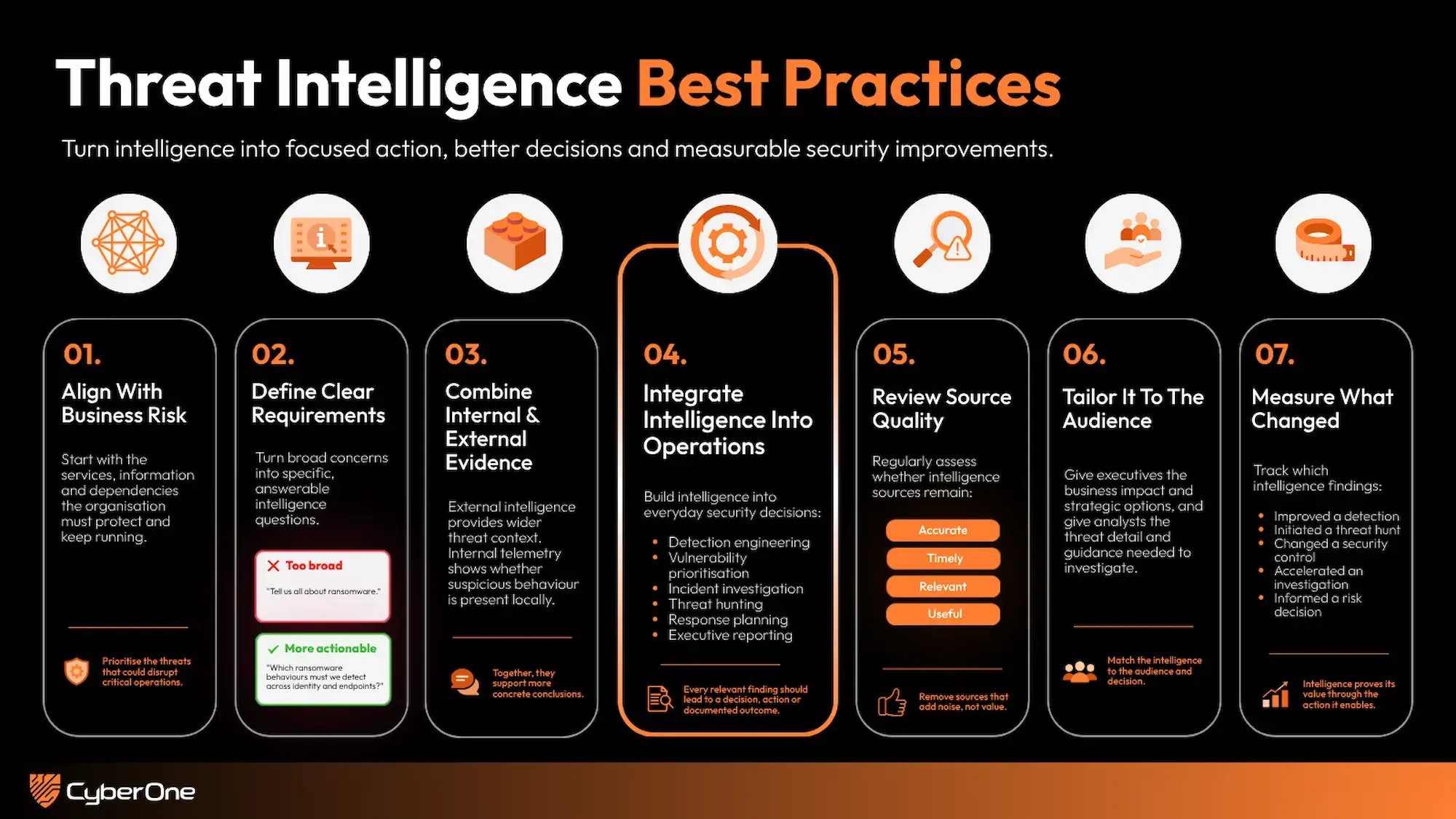
Align Intelligence With Business Risk
Start with the organisation’s critical services, sensitive information, important dependencies and most significant disruption scenarios.
Intelligence priorities should reflect what the organisation needs to protect and keep running.
Define Clear Requirements
Turn broad concerns into answerable questions.
“Tell us about ransomware” is too general. “Which ransomware behaviours must we detect across our identity and endpoint environment?” gives the intelligence team a clearer purpose.
Combine External and Internal Evidence
External intelligence provides context. Internal telemetry reveals whether suspicious behaviour exists locally.
Combining the two helps analysts reach more confident, relevant conclusions.
Integrate Intelligence Into Security Operations
Build intelligence into:
- Detection engineering
- Vulnerability prioritisation
- Incident investigation
- Threat hunting
- Response planning
- Executive reporting
Clear ownership is essential. Relevant findings should lead to a decision, action or documented outcome.
Review Source Quality
Regularly assess whether intelligence sources remain accurate, timely and useful.
Sources that repeatedly create noise without improving decisions should be refined or removed.
Tailor Communication to the Audience
Executives need business implications, potential impacts and strategic options.
Analysts need observables, behaviours, confidence levels and investigation guidance. Tailored outputs make intelligence easier to understand and act on.
Measure Outcomes
Organisations should track what changed as a result of the intelligence.
A mature programme should be able to identify which findings:
- Improved a detection
- Initiated a hunt
- Changed a security control
- Accelerated an investigation
- Informed a risk decision
How CyberOne Helps Organisations Operationalise Threat Intelligence
Many organisations already hold useful security data but struggle to turn it into a consistent operating capability.
Common barriers include fragmented technology, unclear ownership, limited visibility, skills gaps and alert overload that slow progress.
We help organisations connect Microsoft security technology with practical security outcomes. Our Microsoft Sentinel and Defender XDR deployment services focus on linking threat signals, security telemetry and response workflows to improve visibility and detection.
A structured improvement programme can help an organisation:
- Assess current intelligence maturity
- Define intelligence requirements
- Review collection sources and feed quality
- Integrate intelligence with SOC processes
- Improve detection and hunting workflows
- Establish operational and executive reporting
- Create a prioritised improvement plan
Build a More Intelligence-Led Security Operation
Threat Intelligence gives organisations a disciplined way to turn fragmented security data into insight that drives better decisions.
Its value does not come from collecting the greatest number of indicators. It comes from delivering relevant, contextual and timely intelligence to the people and systems that can act on it.
A strong programme:
- Connects intelligence requirements to business risk
- Uses a repeatable lifecycle
- Combines external sources with internal telemetry
- Integrates findings into operational workflows
- Measures whether intelligence improves decisions and outcomes
The result is a more focused security function. Analysts can prioritise investigations more effectively, hunters can develop stronger hypotheses, detection teams can improve coverage and leaders can make risk decisions with greater confidence and clarity.