



As AI moves to consumption-based pricing, the question for leaders is changing. It used to be "What did we buy?" Now it is "what are we getting for what we use?"
What I Mean by AI Tokenomics
From Licences to Cloud Consumption
For a long time, buying business software followed a familiar pattern. You agreed a licence, counted the seats and knew roughly what the year would cost.
Cloud changed that once already. When organisations moved workloads to Microsoft Azure or AWS, they began paying for the compute, storage and data they actually used rather than for fixed infrastructure. That brought real flexibility, but it also showed that a bill driven by consumption can move in ways a licence never did. Managing cloud spend, a practice now widely known as FinOps, became a discipline in its own right as a result.
AI is the Next & Bigger Step
In my view, AI is the next step on that journey and a bigger one. Alongside familiar subscriptions, organisations are now paying for consumption measured in tokens, credits or actions. Microsoft Copilot Studio, the platform for building and managing AI agents, is a good example. Its pay-as-you-go option bills organisations each month for the Copilot Credits their agents actually consume (Microsoft, Copilot Studio Licensing Guidance).
So what is the real difference? It comes down to who drives the bill. With cloud, consumption was largely shaped by technical teams making infrastructure decisions. With AI, it is shaped by every prompt an employee writes and every action an agent takes. The financial commitment no longer stops at the point of purchase, because it is increasingly decided by how people across the business use the technology afterwards.
Defining AI Tokenomics
But I am not interested in tokens for their own sake. The question I want every leader asking is far simpler: what are we paying to get useful work done?
The Pilot Is Not the Bill
Why Scale Changes the Economics
This is where I think many organisations will be caught out.
AI experimentation feels cheap. A pilot with a few dozen users barely registers on the budget. Then it works and the organisation scales it. Hundreds of employees start using Copilot, agents begin running multi-step tasks and automated workflows run throughout the day without anyone pressing a button. Every one of those interactions and actions carries a cost.
None of that is a problem in itself. It becomes a problem when nobody is measuring consumption against the value it returns. In that situation, costs do not simply creep up; they compound.
What Uber's Experience Shows
Uber is the clearest example I have come across. Earlier this year, it exhausted its IT budget within the first quarter as AI use surged (Axios, Uber Cuts AI Costs Even as Usage Jumps). What happened next is the part I find most instructive. By August, Uber reported that weekly agent requests had grown 9.4 times since February, while total AI spend had relatively stabilised since April (Uber, Running a Software Factory Efficiently at Uber Scale).
It did not get there by restricting use; it got there by understanding it. Uber broke its AI spend into its component parts and chose models for each workload based on cost per completed task, output quality and reliability. For its managed agents, it tracked outcome-based costs, such as cost per merged code change or cost per review, alongside quality signals.
Why the Lesson Travels
I would not expect another organisation to reproduce Uber's numbers. Its environment is its own and its engineering depth is exceptional. But the lesson travels well: adoption and expenditure can be managed together, provided you can see what is happening beneath the application.
And a stable bill is only half the story. Whether the business is getting more for that money still has to be proved. That brings me to the point I care about most.
More AI Activity Does Not Mean More Value
Usage Is Not Value
If there is one idea I want leaders to take from this piece, it is this: usage is not value.
I am sceptical of any AI success story that begins and ends with adoption figures. More active users, more prompts and more agent runs tell you people are using the technology. They tell you nothing about whether the business is performing better. Too often, usage dashboards are presented as if they were evidence of return, when they are nothing of the sort.
The research is starting to say the same thing. The AI Ambition Gap, produced independently by The Productivity Institute and commissioned by Bytes, finds that organisations are taking up AI well ahead of their ability to profit from it.
Faster Tasks Do Not Mean Faster Processes
To my mind, the reason is not mysterious. Making one task faster does not make the whole process faster.
Take contract review. AI produces a first assessment in minutes rather than hours, which is genuinely impressive. However, the legal team still checks every clause, still chases missing information and still waits on the same approvals. The contract is signed no sooner than before. The organisation has added an AI cost and kept its bottleneck.
Meanwhile, every assessment consumes resources. Extra drafts, repeated checks and failed attempts all add to the bill without adding a single completed contract. Activity goes up while output stays flat and that is the gap I would want any leader to examine before approving wider deployment.
Be Honest About Time Savings
I would also urge more honesty about time savings. Freeing up an hour of someone's time is an opportunity, not a result. It becomes business value if that hour clears a backlog, serves another customer or improves the quality of the work. It becomes a cash saving only when spending actually falls. Counting every released hour as money in the bank is how AI business cases end up overstated.
A Better Measure of Success
My preferred measure is the cost of a completed business outcome, delivered to the standard the organisation needs. It is harder to calculate than a usage count. It is also the only number I would be comfortable basing an investment decision on.
Understand What Actually Drives the AI Bill
One Request, Many Costs
One reason AI costs are so hard to forecast is that the employee and the system see two different things. The employee sees one request, while the system runs a chain of work.
That request may carry instructions, documents and conversation history. An agent might retrieve information, call a model several times, use other tools and retry steps before it answers. To the person asking, it is one task. Commercially, it can draw on several sources of consumption at once.
Six Factors Behind Every Bill
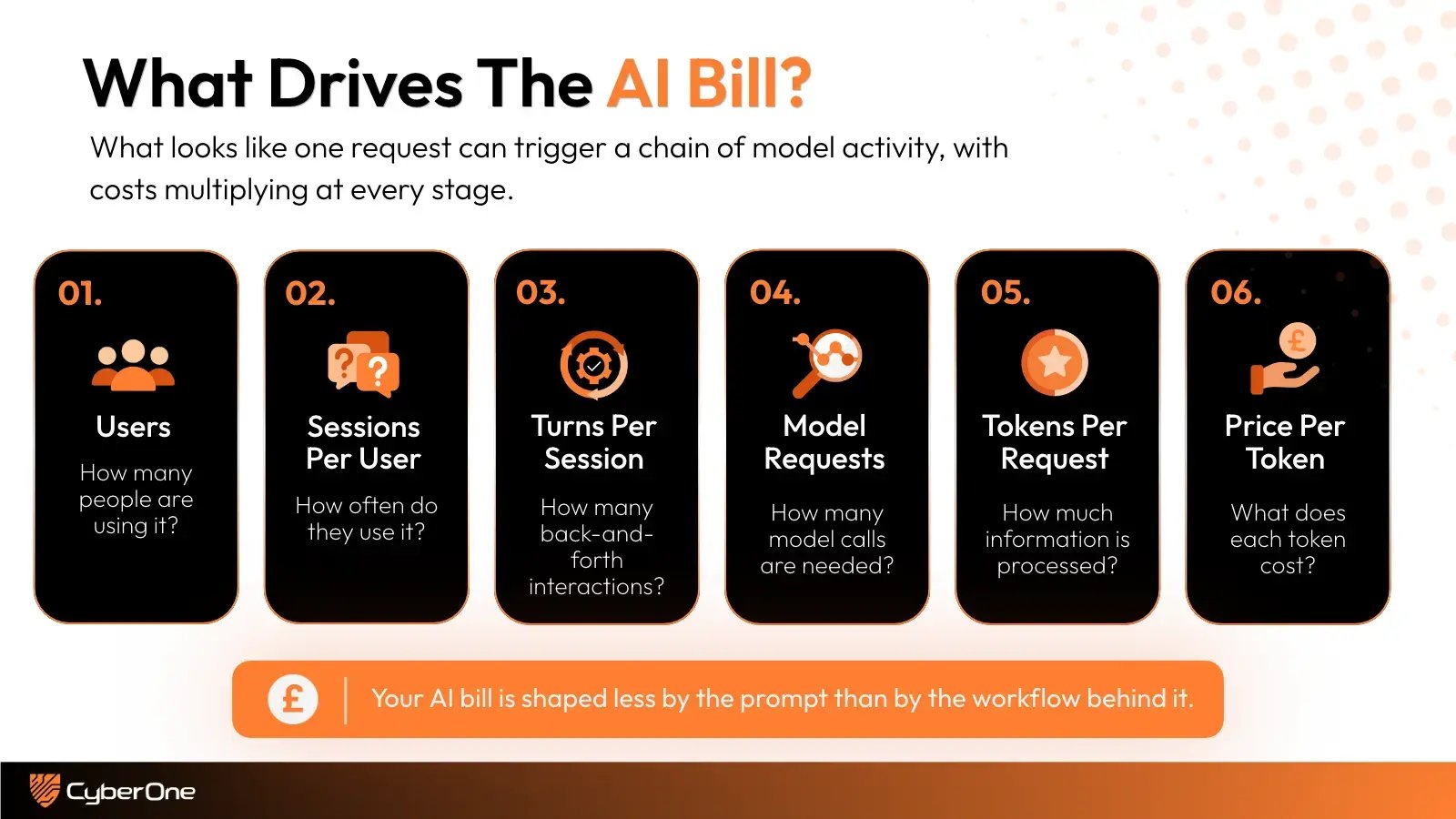
Uber's approach makes this concrete. It breaks total AI spend into a chain of multiplying factors: users, sessions per user, turns per session, model requests per turn, tokens per request and price per token (Uber, Running a Software Factory Efficiently at Uber Scale).
I find that framing valuable because it shows where the real levers sit. Price per token is just one of those six factors. A lower unit price will not protect the budget if consumption grows faster than the price falls. Most of the cost is decided by how work is designed, not by what was negotiated.
Commercial models vary too. Some services charge by tokens, others by credits or actions and some activity is included within subscriptions or allowances. Understanding the actual commercial model is essential before assuming anything about cost.
4 Questions Before You Scale
For any workflow heading towards scale, these are the four questions I would ask:
- Which Model is Doing the Work? Its capability and price should match the task.
- How Much Information is it Processing? Large documents and context supplied over and over again quietly drive up consumption.
- How Many Steps Does it Take? Retries and unnecessary agent activity add cost without adding value.
- What Happens After the AI Responds? Human checking, correction and approval belong in the calculation.
The Cheapest Model Trap
There is one trap I would particularly warn against. Choosing the cheapest model is not automatically good economics. If its output needs heavy correction, the saving on consumption simply moves the cost to someone's desk. Equally, putting the most capable model on every routine task needs justifying. The right comparison is always the total cost of getting the work done reliably.
Budgeting Becomes an Operational Discipline
This is why I believe AI budgeting is becoming an ongoing operational discipline rather than a procurement event. Cloud taught us that lesson once and AI is teaching it again at a faster pace. Procurement sets the terms, but workflow design and everyday use decide what you actually pay.
Fund the Learning, Then Demand the Business Case
Give Experimentation a Budget
I am not arguing that every AI experiment needs a proven return before it starts. Teams need room to learn and some promising ideas will fail, which is healthy. But I would give that learning a defined budget, a clear business hypothesis and a review date.
Make Scaling Earn Its Place
Scaling is a different matter. Before a contract-review workflow goes wider, I would want its full cost, quality and turnaround time compared with the existing process, human review included. I would want clarity on whether the benefit is extra capacity, lower spend or better service. And I would want the team to be willing to change course if the pilot shows the process needs redesigning before more AI will help.
Higher AI spend can be entirely justified when it delivers greater value. The point is to make that a deliberate decision rather than a discovery on the invoice.
Autonomy Needs an Owner
More Authority Means More Risk
As agents take on more responsibility, cost and security become the same conversation. An agent allowed to read a contract is doing a very different job from one allowed to amend it or send it to a customer. Every extension of authority changes what the organisation is trusting it to do.
Clear Rules for Every Workflow
For every material workflow, I would expect a named business owner, an agreed spending limit and clear rules for when a human steps in. Teams should know when an agent must stop retrying, when it needs approval and how essential work continues if it becomes unavailable. That oversight has to cover departmental purchases and employee-built agents too. Otherwise, leaders are making decisions on an incomplete picture of both spend and exposure.
Finance can watch the spend and technology can run the platform, but someone in the business has to own the outcome.
5 Questions I Would Put to the Board
If I were shaping board reporting on AI, I would build it around five questions:
- What Are We Spending?
The board should see actual and forecast costs for material use cases, including the cost of human review. - What Has Improved?
There should be clear evidence of better cost, quality, speed or customer outcomes. - Has The Whole Process Improved?
The gains need to survive approvals, rework and handovers, not just look good at task level. - Who is Accountable?
Every material use case should have a named owner for the outcome, the budget and the actions the AI is permitted to take. - What Decision Does the Evidence Support?
The report should end with a clear recommendation to expand, improve, pause or retire the use case.
Where I Think This is Heading
My view is that the next phase of AI adoption will be won on economics, not enthusiasm. As models become more capable, the opportunities to delegate work will multiply. So will the opportunities to spend money without improving the result. The organisations that pull ahead will be the ones that understand the cost of completed work well enough to know where greater capability deserves greater investment.
Where to Start
My advice is to start small and specific. I would pick a handful of significant workflows, establish their full cost, test the claimed improvement and close any ownership gaps before scaling further.
That is the thinking behind CyberOne's AssureAI service, a structured AI readiness review and roadmap covering usage, governance, security and cost control. If you need a clearer starting point, it will show you where the gaps are and which improvements matter most.