



Artificial intelligence is evolving from simply generating content to taking action. A new generation of AI can now make decisions, carry out tasks and interact with business systems with limited human input.
This shift is driving interest in Agentic AI vs Generative AI, especially among business leaders aiming to automate complex processes, boost productivity and deliver measurable transformation. Both approaches use large language models, but their roles in the business are distinct.
Understanding the difference matters as organisations look to harness AI for growth while keeping risk under control.
What Is the Difference Between Agentic AI and Generative AI?
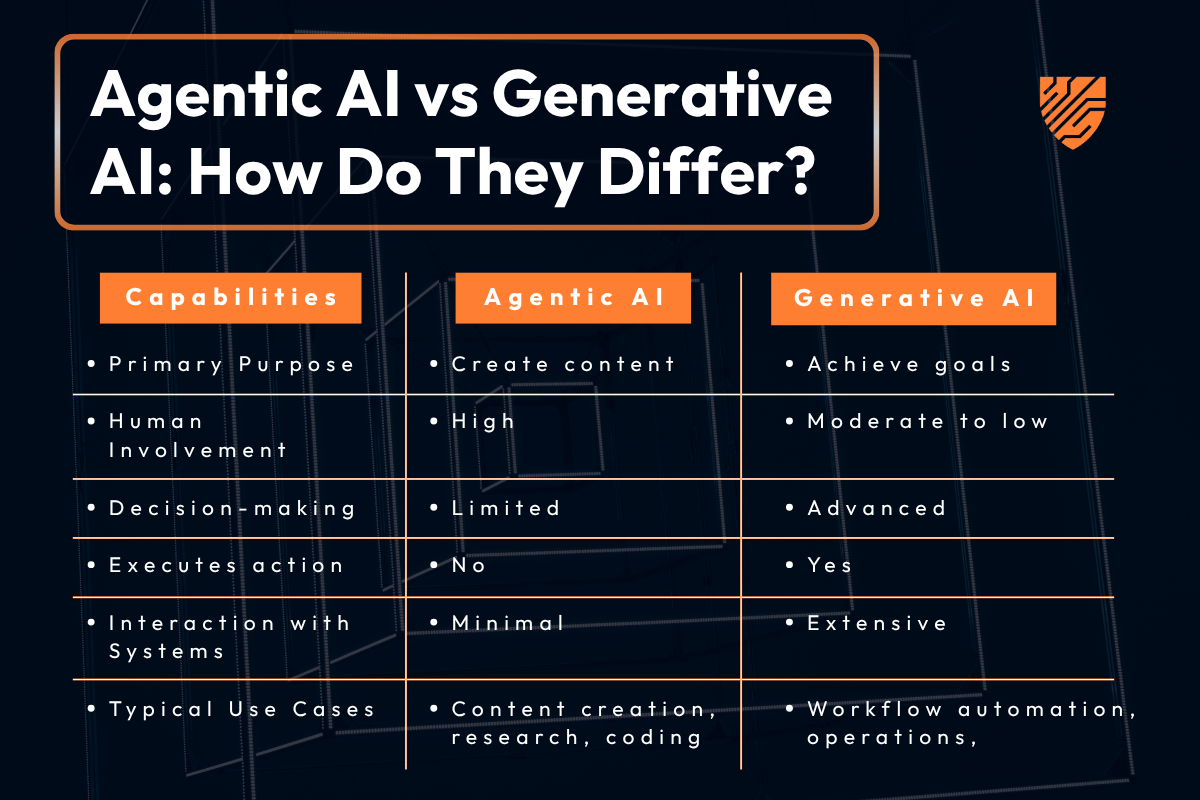
The clearest way to distinguish Agentic AI vs Generative AI is by their core purpose.
Generative AI Creates, Agentic AI Acts
Generative AI is designed to generate outputs based on user prompts. Those outputs might include:
- Text
- Images
- Summaries
- Code
- Recommendations
For example, a user might ask Microsoft Copilot or ChatGPT to draft an email, summarise a document or create a project plan. The AI provides the output, but the user decides the next step.
Agentic AI takes the concept further. Rather than stopping at content generation, it can:
- Understand goals
- Plan actions
- Execute tasks
- Interact with applications and systems
- Adapt its approach based on results
Instead of just generating a project plan, an agentic system could create the plan, schedule meetings, assign tasks and track progress towards business objectives.
Why the Difference Matters
Many organisations are already seeing measurable productivity gains from Generative AI. Teams can produce reports faster, communicate more clearly and access information when they need it.
Agentic AI opens up new opportunities by automating multi-step processes that previously relied on manual effort.
This has the potential to improve:
- Operational efficiency
- Service delivery
- Process consistency
- Scalability
- Workforce productivity
Greater autonomy makes strong governance and oversight even more important.
How Do Agentic Workflows Differ From Static Generative Prompts?
The fundamental difference lies in how the AI approaches a task.
From Prompt-and-Response to Goal-Oriented Workflows
Traditional Generative AI follows a straightforward pattern:
- User enters a prompt.
- AI generates a response.
- User evaluates the output.
- User provides another prompt if needed.
This process is reactive and depends on ongoing human input.
Agentic workflows are built differently.
A user provides a goal such as:
"Investigate security alerts, identify high-priority incidents and create remediation tickets."
The agent works out how to achieve the goal and completes the necessary steps. This allows AI to perform sophisticated activities that involve multiple actions and decision points.
The Technologies Behind Agentic AI
Several key technologies make this possible.
Reasoning and Planning Engines
Reasoning and planning engines enable AI systems to:
- Break goals into tasks
- Evaluate different approaches
- Prioritise actions
- Adapt when circumstances change
Instead of following a fixed set of instructions, the AI can choose the most effective way to reach the goal.
LLM-Powered Agents
LLM-powered agents use large language models as their decision-making layer.
These agents can:
- Interpret objectives
- Understand context
- Make recommendations
- Select appropriate actions
The language model acts as the intelligence driving operational workflows.
Reflection and Self-Correction in AI
A key advancement in Agentic AI is its ability to reflect and self-correct.
This allows systems to:
- Review completed actions
- Assess outcomes
- Detect errors
- Refine future decisions
This leads to greater adaptability and better performance over time.
A Practical Example
Imagine an employee needs information about pending invoices.
A Generative AI assistant might:
- Summarise invoice data
- Generate a report
- Highlight overdue payments
An agentic system could:
- Access financial systems
- Identify overdue invoices
- Contact relevant stakeholders
- Update records
- Escalate issues where necessary
Both approaches add value, but they operate with very different levels of autonomy.
When Should Businesses Use Generative AI Versus Agentic AI?
There is no one-size-fits-all answer when comparing Agentic AI vs Generative AI. The right choice depends on the business objective.
Where Generative AI Delivers the Most Value
Generative AI is highly effective for content creation and knowledge support tasks.
Common use cases include:
- Drafting emails and reports
- Creating marketing content
- Summarising meetings
- Generating code
- Conducting research
- Supporting customer service interactions
These activities benefit from speed and creativity, but still need human oversight.
Where Agentic AI Excels
Agentic AI is most valuable when organisations need to automate processes across multiple systems.
Examples include:
- Security operations
- IT service management
- Supply chain workflows
- Customer onboarding
- Compliance monitoring
- Incident response
In these scenarios, autonomous AI agents can reduce manual effort and improve consistency.
The Rise of Multi-Agent Systems
Many organisations are also exploring multi-agent systems. Instead of relying on a single AI agent, multiple specialised agents can work together to achieve a shared goal.
For example:
- One agent gathers information
- Another analyses data
- Another executes actions
- A supervisory agent validates outcomes
This approach improves scalability and supports more complex decision-making across business functions.
Tool Integration and Execution
A key difference between Agentic AI and Generative AI is the ability to integrate with and execute actions across business tools.
Agentic systems can connect with:
- CRM platforms
- ERP systems
- Security tools
- Productivity applications
- Collaboration platforms
This ability to interact directly with business applications turns AI from a passive assistant into an active part of operations.
Choosing the Right Approach
When evaluating AI adoption, businesses should consider:
- How complex is the task?
- Does it require multiple actions?
- Is decision-making involved?
- What level of autonomy is acceptable?
- What governance controls are required?
Most organisations will use both technologies together, rather than relying on one alone.
Conclusion
The difference between Agentic AI and Generative AI is becoming more important as organisations look for new ways to improve efficiency and automate operations.
Generative AI creates content and supports decision-making. Agentic AI goes further, planning, acting and executing tasks to achieve business goals. Technologies like LLM-powered agents, reasoning and planning engines, tool integration and self-correction are driving this shift.
The opportunity is clear, but so is the need for strong governance.
Organisations that combine innovation with strong security, clear accountability and effective oversight will be best placed to realise the benefits of AI while maintaining trust, compliance and resilience.

.webp?width=767&name=Cyber%20Awareness%20Month%202026%20AI,%20Responsibility%20And%20The%20Future%20Of%20Cyber%20Security%20(1).webp)