



Most organisations are not short of security data. Alerts arrive from endpoints, identities, email, cloud workloads, applications and network infrastructure. The real challenge is turning these signals into clear decisions and prompt action that reduce risk.
Fragmented tools can create fragmented investigations. An identity alert may appear in one console while related endpoint, email and cloud activity sit elsewhere. Internal teams must connect that information, determine whether it represents a genuine threat and decide how to respond, often while managing competing operational priorities.
Managed Extended Detection and Response (MXDR) closes this gap by uniting connected security technology with continuous monitoring, expert investigation and coordinated response. It provides organisations with a practical operating model to detect, contain and learn from threats across the digital estate.
MXDR is a managed security service that brings together cross-domain visibility, continuous monitoring, expert investigation and coordinated response. It enables organisations to identify and contain threats across endpoints, identities, email, applications, networks and cloud environments.
An effective MXDR service delivers more than alerts, dashboards or technology access. It establishes clear responsibilities, accelerates security decisions and provides evidence that helps leaders track progress towards greater resilience.
This guide sets out how MXDR works, how it differs from other security approaches, how Microsoft underpins the operating model and what buyers should expect from a provider.
What Is Managed Extended Detection & Response?
Managed Extended Detection and Response brings technology, security expertise and incident processes together as an ongoing managed service.
The goal is to connect signals across the organisation, investigate suspicious activity and coordinate the right response. This broader context helps analysts see attacks as connected events, not isolated alerts.
What Does MXDR Stand For?
Each part of the name describes an important element of the service:
- Managed: A specialist provider performs agreed security operations on behalf of, or alongside, the organisation’s internal team.
- Extended: Detection extends beyond the endpoint to other relevant domains, including identity, email, applications, software-as-a-service platforms, cloud workloads and network telemetry.
- Detection: Technology and analysts identify, correlate, prioritise and investigate potentially malicious activity.
- Response: The provider and customer take action according to documented responsibilities, escalation routes and response authority.
The “managed” and “response” elements are particularly important. Extended visibility may reveal more activity, but visibility alone does not contain a compromised account, isolate a device or coordinate an incident.
Buyers should look beyond the number of integrations or security signals a service advertises. The real questions are what the provider will investigate, which response actions it can perform, how quickly decisions are made and how progress will be demonstrated.
What Does an MXDR Service Cover?
Coverage differs between providers, but an MXDR service can bring together relevant telemetry from:
- Endpoints and servers
- User and privileged identities
- Email and collaboration services
- Cloud services and workloads
- Business applications
- Software-as-a-service environments
- Network and security infrastructure
- Relevant third-party technologies
CyberOne’s MXDR readiness guidance describes the importance of telemetry across endpoint, identity, software-as-a-service, cloud and network environments. It also stresses that successful MXDR requires suitable access, communication routes, governance and executive sponsorship.
Coverage must be validated, not assumed. Buyers need clarity on which assets, data sources, users and environments are in scope, how integrations will be checked and how coverage will adapt as the organisation evolves.
Why Are Organisations Moving Towards MXDR?
The case for MXDR is not just about the existence of cyber threats. Organisations have managed that reality for years. The real issue is that digital estates and security operations have become increasingly difficult to coordinate.
Fragmented Security Visibility
A modern incident can involve several parts of the digital environment. A suspicious email might lead to credential misuse, abnormal identity activity, access to a cloud application and malicious execution on an endpoint.
If each signal is handled separately, the investigation can lose context. Analysts may spend valuable time moving between products, gathering evidence and determining whether apparently unrelated activity is part of the same incident.
MXDR connects that context. It gives analysts a broader view of potentially malicious activity and establishes a process for moving from detection to investigation and response.
Pressure on Internal Security Teams
Maintaining effective security operations requires a combination of technical platforms, specialist expertise, management oversight and dependable processes. Organisations must decide how alerts will be prioritised, who will investigate them, who has authority to act and how coverage will be sustained outside standard working hours.
This is not solely a staffing question. Even a capable internal team can be constrained by disconnected processes, incomplete telemetry or unclear response responsibilities.
A managed XDR service extends the internal team with additional monitoring, investigation, threat-hunting and response capability. The organisation retains strategic risk ownership, while gaining an operational partner with clear responsibilities.
The Gap Between Detection & Action
A detection alone does not deliver a security outcome.
Someone must establish whether the activity is malicious, determine the potential business impact and choose an appropriate action. During a significant incident, any uncertainty about responsibilities or approval routes can add friction when decisions need to be clear.
That is why response authority is central to an MXDR operating model. Before the service begins, the provider and customer should agree which actions can be taken immediately, which require approval and who owns escalation at different levels of severity.
Greater Demand for Evidence
Senior leaders need to see what their security investment is achieving. A report full of alert totals may show activity, but it does not prove improved resilience.
Useful reporting explains meaningful incidents, affected assets, response actions, recurring weaknesses, coverage gaps and improvement priorities. It should also highlight decisions that need leadership attention.
CyberOne’s MXDR service provides operational reports, key performance indicators, trends and auditable information, alongside a portal for incidents, evidence and roadmap items.
How Does MXDR Work?
Although service designs vary, managed extended detection and response can be understood as a continuous five-stage lifecycle:
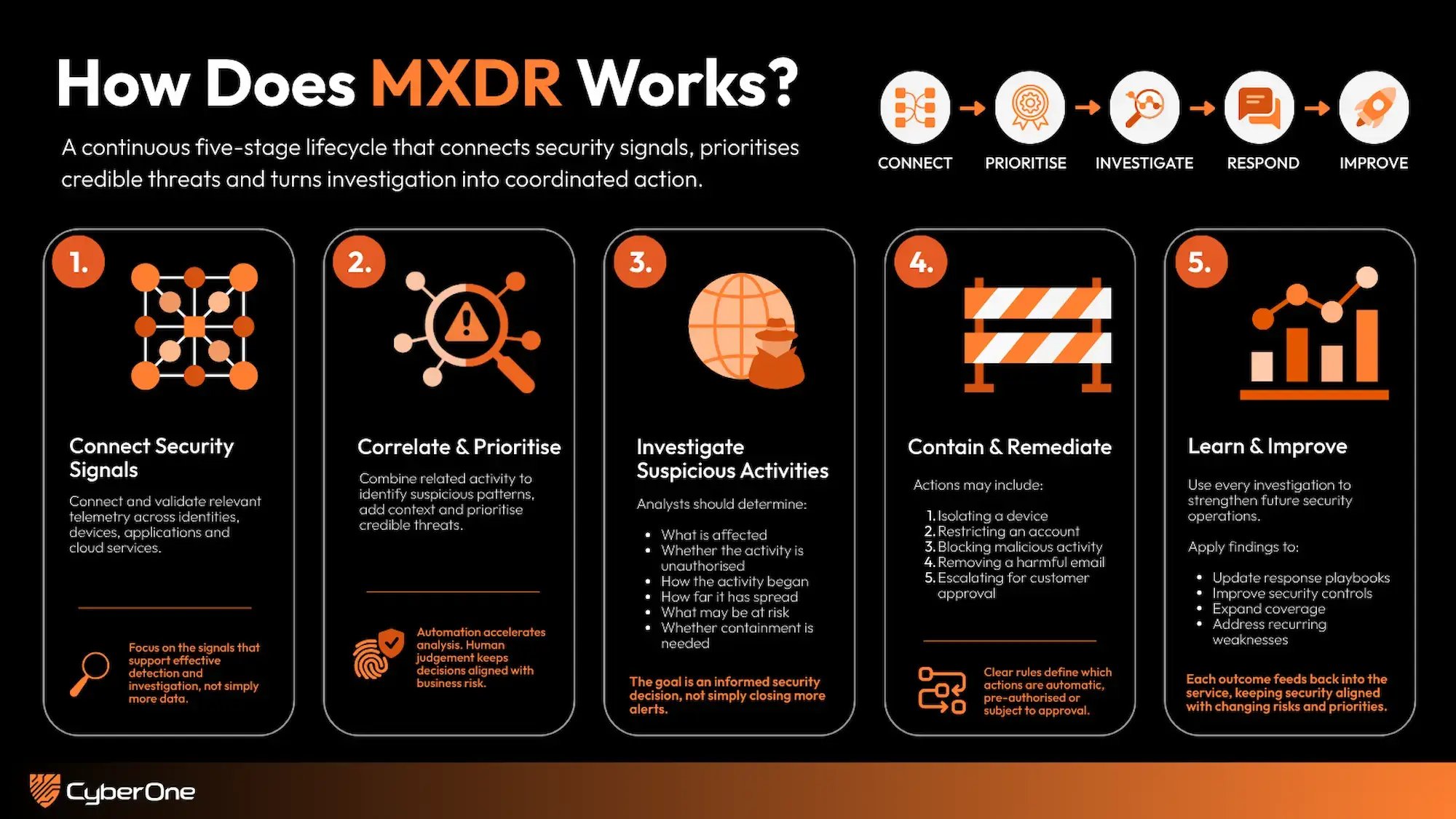
1. Connect Security Signals
The first stage is to establish appropriate visibility across the organisation’s digital estate.
Security telemetry must be connected, validated and maintained. The provider needs to understand which identities, devices, applications and services are most important, as well as the business context in which they operate.
More data does not always mean better security. Collection should support relevant detection and investigation use cases. Unnecessary or poorly governed telemetry adds cost and complexity without delivering equivalent value.
2. Correlate & Prioritise Potential Threats
Once signals are available, analytics and detection logic can identify suspicious patterns.
An individual event may be harmless in isolation. When combined with unusual identity activity, endpoint behaviour or cloud access, it may become more significant. Correlation helps analysts see these relationships and prioritise credible threats.
Automation can enrich alerts, gather context or trigger predefined workflows. Threat intelligence helps analysts understand malicious infrastructure, campaigns or techniques. Human judgement remains essential, as technology cannot know every aspect of an organisation’s users, systems, risk tolerance and operational priorities.
3. Investigate Suspicious Activity
Qualified analysts examine the available evidence and determine what has happened.
A strong investigation should establish:
- Which identity, device, application or service is affected
- Whether the activity is expected or unauthorised
- How the activity began
- Whether it has moved across different systems
- What information or operations may be at risk
- Whether immediate containment is necessary
- What additional evidence is required
This stage turns a technical signal into an informed security decision. The quality of investigation matters more than the number of alerts processed.
4. Contain & Remediate Incidents
Response arrangements should be agreed before a live incident.
A provider might be authorised to isolate a device, disable or restrict an account, block malicious activity, remove a harmful email or initiate another defined containment action. The exact capability depends on the technology, service scope and authority granted by the customer.
Some actions may be pre-authorised. Others may require customer approval because they could affect an important user or business service. The operating model should document those boundaries and identify who can make each decision.
5. Learn and Improve
A mature service does not reset to the same baseline after each investigation.
Findings should inform detection tuning, playbook updates, control recommendations and coverage improvements. Recurring incidents may indicate a technical weakness, a process issue or a wider security maturity gap.
This creates a continuous cycle where security operations stay aligned with the organisation’s changing environment and priorities.
CyberOne's services includes managed services, including rules of engagement, response playbooks, escalation routes, service governance and IT service management integration. Threat hunting, detection tuning and AI-augmented investigation were used as part of ongoing operational improvement.
What Is the Difference Between EDR, XDR, MDR, MXDR, SIEM & a Managed SOC?
Security terminology often blurs the lines between technology, operational capability and managed service. Provider definitions vary, so buyers should focus on the actual scope rather than the acronym.
EDR
Endpoint Detection and Response focuses on activity affecting devices such as workstations and servers. It helps security teams detect, investigate and respond to suspicious endpoint behaviour.
EDR is an important capability, but an attack may also involve identity, email, cloud and application activity that cannot be understood completely from endpoint information alone.
XDR
Extended Detection and Response connects detection and investigation across multiple security domains. Its purpose is to give analysts broader context and support more coordinated response.
CyberOne’s Microsoft Defender XDR service covers endpoints, identities, emails and applications. XDR is primarily a technology capability or platform. Organisations still need people and processes to configure, monitor, investigate incidents and govern response.
MDR
Managed Detection and Response provides monitoring and expert investigation as a service. Historically, many MDR services have concentrated strongly on endpoints, although the term is used differently across the market.
Buyers should not assume every MDR service offers the same coverage. Ask which technologies are monitored, what response is included and how incidents spanning multiple domains are handled.
MXDR
Managed Extended Detection and Response combines cross-domain detection with an ongoing managed operating model.
The provider supplies security expertise and performs agreed monitoring, investigation, hunting and response activities. The “extended” component indicates broader visibility, while the “managed” component establishes operational responsibility.
SIEM
Security Information and Event Management technology centralises and analyses security information from different sources. It can support detection, investigation and reporting across a diverse environment.
However, a SIEM does not provide a complete security operation by itself. Organisations still need to design detections, manage data, investigate incidents, maintain integrations and coordinate response.
Managed SOC
A managed Security Operations Centre supplies operational security capability through an external provider. Its activities may include monitoring, triage, investigation, threat hunting, response and reporting.
There is often overlap between a managed SOC, MDR and MXDR. The service label matters less than the actual coverage, expertise, availability, response authority, governance and accountability the provider delivers.
Microsoft Sentinel is at the centre of CyberOne’s managed SOC service and it works alongside broader Microsoft security technologies.
What Business Outcomes Should MXDR Deliver?
A successful MXDR service is measured by its contribution to resilience, not just by activity.
Faster Investigation and Containment
Connected context helps analysts understand incidents without manually piecing together signals from separate systems. Defined response procedures reduce uncertainty about the next action.
Useful measures include time to acknowledge, investigate and contain an incident. These should be interpreted in context, as incident complexity and business constraints can affect response decisions.
Greater Visibility Across the Digital Estate
MXDR helps organisations identify whether critical assets and identities have the right monitoring coverage. It also exposes blind spots, missing integrations and areas where available telemetry does not support effective investigation.
The aim is not perfect visibility, but greater transparency and a clear process for improvement.
Reduced Operational Pressure
A managed service provides additional specialist capability and continuous operational support. This allows internal leaders to focus on governance, architecture, risk treatment and business priorities.
This does not remove the need for internal ownership. The organisation still needs people who understand the business, make operational decisions and ensure provider activity stays aligned with risk.
Consistent Incident Handling
Documented playbooks, named owners and clear escalation routes make security decisions more repeatable.
Consistency is especially important when incidents occur outside normal working hours or affect multiple teams. The operating model should make it clear what will happen, who is involved and how evidence is recorded.
Board-Ready Security Visibility
Senior leaders do not need a reproduction of the security console. They need an informed view of material risks and outcomes.
Reporting should help them understand:
- What significant activity occurred
- What was investigated or contained
- Which critical assets are covered
- Where material gaps remain
- Which improvements have been completed
- What decisions or investment may be required
How Does Microsoft Support an MXDR Operating Model?
Microsoft provides the security platform for connected detection, investigation and response. An effective MXDR service adds the operational expertise, engineering, governance and accountability needed to realise its value.
Microsoft Sentinel as a Security Operations Foundation
Microsoft Sentinel can centralise security telemetry and support analytics, investigation, automation and security operations workflows.
For an MXDR provider, Sentinel creates a wider view across Microsoft and relevant non-Microsoft environments. Its value depends on the quality of connected data, the detections in place, how investigations are managed and the operational processes that support it.
A Microsoft Sentinel managed service must cover more than administration. Buyers should look at how the provider manages data, validates integrations, tunes detections, investigates incidents and controls operational costs.
Microsoft Defender XDR & Connected Context
Microsoft Defender XDR unifies signals across Microsoft security domains, giving analysts connected context across identities, endpoints, email and applications.
In an MXDR operating model, this context supports investigation and response. Analysts can examine relationships between events, assess the potential reach of an incident and determine the right action.
Why Technology Still Requires Expertise
Buying or enabling a security platform does not create a mature security operation. The organisation still needs:
- Architecture and configuration
- Data onboarding and validation
- Detection engineering
- Investigation capability
- Threat hunting
- Response procedures
- Escalation routes
- Reporting and governance
- Continuous tuning and improvement
CyberOne’s Microsoft Sentinel and Defender XDR service describes the technologies as connecting threat signals, security telemetry and response workflows. It positions CyberOne’s role around designing and deploying them to support operational processes, security objectives and compliance requirements.
Microsoft supplies the strategic security platform. CyberOne brings the expertise and operating model needed to turn its capabilities into measurable security outcomes.
How Should Buyers Evaluate an MXDR Provider?
The right provider explains what it will protect, how it will act and how it will prove value.
Confirm the Scope of Coverage
Ask which security domains, technologies, assets and users are included. Confirm any exclusions and determine how coverage is validated.
A provider should also explain how new systems are brought into scope and how telemetry gaps are identified.
Establish Response Authority
Determine whether the provider will only notify your team or whether it can perform containment actions.
Ask:
- Which actions can be pre-authorised?
- Which actions require approval?
- Who is contacted outside working hours?
- What happens when an approver is unavailable?
- How are actions and decisions recorded?
- Who leads a major incident?
Assess Investigation and Threat-Hunting Capability
Ask for evidence of how analysts investigate incidents. Understand how the provider combines automation with human judgement and how it assures investigation quality.
Threat hunting should also be defined carefully. Buyers should understand whether it is scheduled, intelligence-led, incident-led or included only in certain service levels.
Test the Provider’s Microsoft Expertise
For a Microsoft environment, general security experience is not enough. The provider must demonstrate practical capability across Sentinel and Defender technologies and explain how it manages their integration.
CyberOne has achieved Microsoft Verified Managed XDR solution status. This recognition covers a security operations centre with continuous proactive hunting, monitoring and response built on integrations with the Microsoft security platform.
Examine Onboarding & Transition
The provider should explain how it will:
- Establish roles and responsibilities
- Identify critical assets and identities
- Connect and validate telemetry
- Agree escalation routes
- Document response authority
- Establish baseline activity
- Prioritise detection use cases
- Integrate with relevant operational processes
- Measure readiness for managed operation
Review the Reporting Model
Ask for examples of operational and leadership reporting.
Reports should show meaningful outcomes, coverage, material incidents, recurring weaknesses and improvement activity. They should make clear what requires action from the provider, the internal team or senior leadership.
Understand the Commercial Model
The full cost may include service fees, licences, data ingestion, optional capabilities, integration work and out-of-scope activity. Understand these elements before making a decision.
Ask how changing data volumes, additional assets or new integrations affect the commercial model. Exit and transition arrangements should also be understood before the contract is signed.
Demand Evidence
A polished demonstration does not equal an operational service.
Request evidence such as:
- Documented service responsibilities
- Sample reports
- Response playbooks
- Escalation examples
- Relevant customer references
- Accreditation and verification details
- Service review arrangements
- Proof-of-value criteria
The MXDR Buyer’s Guide recommends comparing providers using detection quality, response authority, coverage, total cost, proof of value and structured onboarding rather than relying on demonstrations alone.
How Can Organisations Build the Business Case for MXDR?
A strong business case starts with the current operating model.
Map your organisation’s security licences, internal roles, existing providers, data costs, out-of-hours arrangements and manual investigation effort. Identify duplication, underused technology and unclear ownership.
Next, define the problems MXDR should solve. These may include slow containment, incomplete visibility, inconsistent investigations, limited reporting, specialist skills gaps or excessive reliance on individual employees.
Agree success measures before procurement. Relevant measures may include:
- Coverage of critical assets and identities
- Time to acknowledge and investigate incidents
- Time to contain confirmed threats
- Detection gaps identified and addressed
- Repeat incident patterns
- Control improvements completed
- Quality and usefulness of stakeholder reporting
- Delivery against the security roadmap
These measures must connect to business priorities such as operational continuity, financial exposure, customer assurance, contractual commitments and cyber maturity.
The business case should not promise incidents will never occur. Its purpose is to show how the organisation will detect, contain, recover from and learn from security events more effectively.
What Does Successful MXDR Implementation Require?
Implementing MXDR is an operating-model change, not just a technology deployment.
The organisation and provider should first agree responsibility for monitoring, investigation, approval, containment, recovery, communications, evidence and reporting.
Critical assets and identities should be prioritised so that the service reflects business risk rather than treating every signal as equal. Escalation routes and response authority should be tested, not left as assumptions in contractual documents.
Telemetry should then be connected, validated and tuned. The provider should establish a baseline, confirm that required detections operate as expected and identify meaningful gaps.
Finally, value should be reviewed continuously. Service reviews should assess incidents, trends, coverage, improvements and future priorities. That allows the MXDR service to evolve alongside the organisation.
Why Choose CyberOne for MXDR as a Service?
CyberOne delivers an AI-augmented MXDR service powered by Microsoft and operated within the customer’s Microsoft environment. Its published service includes continuous security operations, Microsoft Teams integration, a customer portal, threat intelligence, operational reporting and board-ready evidence.
CyberOne’s approach combines Microsoft Sentinel, Microsoft Defender XDR and Microsoft security engineering with managed investigation, response and continuous improvement.
Speak with CyberOne about your current security operations, Microsoft environment and response requirements. CyberOne can help you identify coverage gaps, clarify the right operating model and define the outcomes your MXDR service should deliver.
Book an MXDR consultation with a CyberOne expert.